
S2P Process for Indian Businesses: From Sourcing to GST-Compliant Supplier Payment
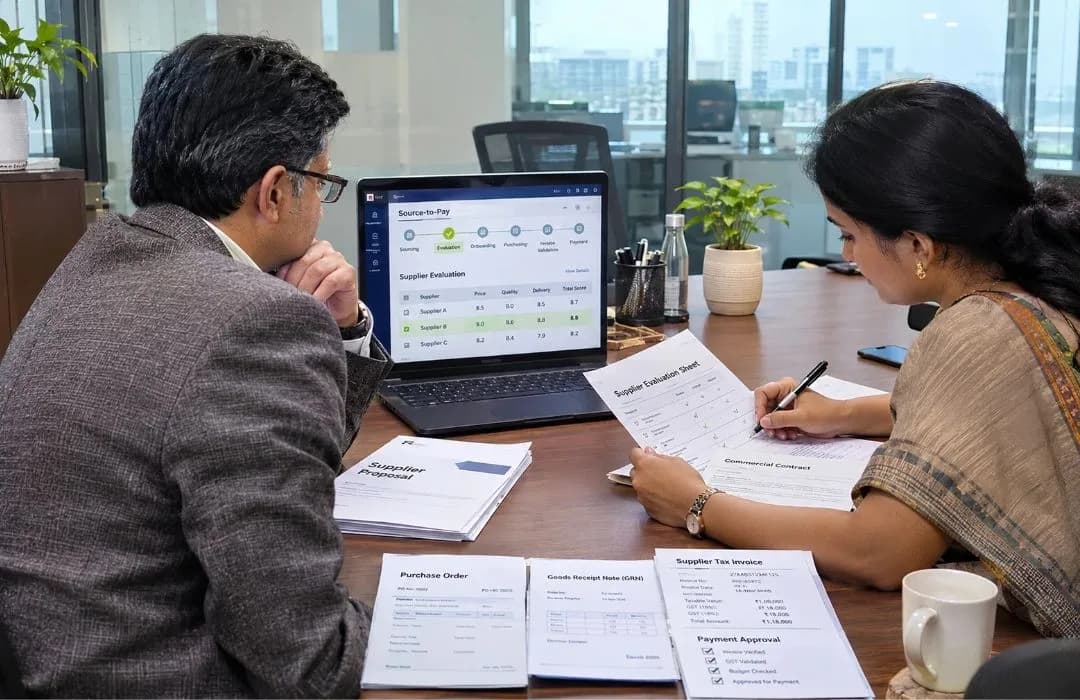
The S2P process integrates sourcing suppliers, procurement, processing invoices and paying suppliers into a single process. It has a second layer for Indian businesses, as checks for Goods and Services Tax (GST), e-invoicing, Tax Deducted at Source (TDS) and payments to micro and small enterprises are part of the same cycle.
The problem is that no one team has access and visibility to the entire process. Procurement teams select suppliers. Operations teams confirm deliveries. Accounts Payable (AP) teams review invoices, and Finance teams approve payments and manage tax. When these teams work on disconnected systems, CFOs, Finance Controllers, AP and Procurement Heads are left with poor spend visibility, invoice mismatches, missed MSME payment deadlines and avoidable compliance exposure.
What Is the S2P Process?
The source-to-pay process starts with identifying a need, moving through to selecting a supplier, receiving goods or services, processing invoices and paying. It covers the entire lifecycle: spend analysis, supplier selection, contracting, onboarding, purchasing, invoice validation and payment. Procure-to-pay (P2P) is the purchasing-to-payment portion of this broader S2P lifecycle. Supplier selection and contract terms influence the compliance requirements that Finance will need to deal with later.
The sequence below shows each stage with its India-specific compliance checkpoint.
1. Spend analysis → | 2. Sourcing → | 3. Contracting → | 4. Onboarding |
Flag fragmented, off-contract and inconsistently priced spend | Supplier due diligence and compliance checks alongside price, quality and delivery | Payment terms within MSMED limits for qualifying suppliers; tax provisions agreed | GSTIN, PAN, bank ownership and MSME status verified as applicable |
5. Purchase order → | 6. Goods receipt → | 7. Invoice matching → | 8. Payment |
Approval and budget check before issue | GRN or service acceptance record logged; acceptance date starts the MSME clock | Three-way match; GST and e-invoice (IRN) checks where applicable; ITC review by Finance | TDS where applicable; MSME due date checked before release |
Spend Analysis and Sourcing
Spend analysis shows what the business buys, how much it spends and with whom. It can reveal fragmented supplier spending, purchases outside approved contracts and inconsistent pricing across locations, and show where suppliers can be consolidated.
Sourcing follows this process. Procurement identifies suppliers, requests quotations and compares them against the agreed requirements. Alongside price, teams should consider delivery capacity, quality, commercial terms, reliability, and supplier due diligence and compliance checks.
This is because the cheapest quotation is not always the one that costs least when the invoice is paid. Commercial terms, supplier reliability, compliance requirements and payment conditions all affect total cost and the downstream Finance workload: a low quotation with unreliable delivery, unclear tax terms or short payment terms can mean rework, disputes and manual follow-up later. These terms should be recorded in S2P procurement at the sourcing stage so that they carry through to contracting, purchase orders and payment.
Contracts and Supplier Onboarding: GSTIN, PAN and MSME Status
The scope of supply, agreed rates, delivery terms, payment terms and tax provisions should all be specified in the contract. These are the basis for all that follows, from the PO to the final invoice. Then, the vendor record is created during onboarding. It needs to be up to date, as registration status, bank information and classification are all subject to change.
Check GSTIN and PAN
The Goods and Services Tax Identification Number (GSTIN) identifies a supplier registered under GST. Not every supplier has identical GST registration requirements, so these checks should be performed as appropriate to the supplier and the transaction. Teams verify it with the supplier's legal name and status. The Search Taxpayer option on the GST Portal provides the legal name, trade name and registration status of a GSTIN or UIN.
Three checks serve different purposes. GST registration status confirms the supplier’s GST registration. Validating the Permanent Account Number (PAN) confirms the tax identity on the record. Bank account ownership must be verified independently, because a valid GSTIN or PAN does not mean that the account being paid belongs to that supplier. Accurate supplier master data then supports the purchase orders, invoice validation and payments that follow.
Confirm MSME Status
Check if the supplier is a micro or small business on the official Udyam Registration portal. This is important because the Micro, Small and Medium Enterprises Development (MSMED) Act, 2006 provides for payment protection for qualifying micro and small suppliers. These protections apply to qualifying micro and small suppliers, not automatically to every MSME category, so classification should be verified, kept current and supported by records such as the Udyam registration certificate. Classification affects delayed-payment interest obligations under the MSMED Act and the restriction on deducting such unpaid amounts as a business expense under the applicable income-tax provisions.
Purchase Orders and Goods Receipt
The purchase order (PO) is the document that records the authorised purchase. It lists the supplier, items or services, quantities, agreed prices and delivery expectations. Before issuing one, make sure it has the necessary approvals and is within budget.
Then document what comes in: a goods receipt note (GRN) for goods, and a service acceptance record for services to confirm receipt against the contracted deliverables or milestones, not merely that the work has finished. These records feed invoice matching and payment approval, and the acceptance date also starts the MSME payment clock for qualifying suppliers.
Say a company orders 500 components and receives 480. The receiving record should mention 480. If the supplier invoices for all 500, a connected S2P workflow flags the 20-unit discrepancy against the PO and receipt record and routes it for resolution before payment, through a corrected invoice, a credit note or an authorised exception. The same applies to milestone-based service contracts, too.
Invoice Matching: GST and E-Invoice Checks
Invoice validation is the main checkpoint for GST compliance.
Perform a Three-Way Match
A three-way match is a comparison between the purchase order, goods receipt note/service acceptance record and supplier invoice. It helps determine if the goods or services are the same as the approved purchase and the amount received.
An invoice can have a different unit price or quantities than what the business receives. These are identified by a matching workflow before they are approved. Identifying a mismatch is not the same as resolving it: a flagged invoice should be investigated, corrected or approved through an authorised exception process before payment. Duplicate invoice numbers, incorrect tax calculations and invoices raised against cancelled POs are also flagged.
Validate GST Details
The GST Portal auto-drafts GSTR-2B based on the information provided by the supplier in the invoice and other documents. Businesses can use this to check the availability of input tax credit (ITC) for their purchases. However, the mere appearance of an invoice in GSTR-2B does not mean that the business is entitled to claim ITC. The eligibility conditions need to be checked by Finance. Finance must verify the applicable statutory conditions and supporting documentation before claiming ITC. A platform can match invoice data and flag exceptions, but it cannot establish ITC eligibility on its own.
Check E-Invoices Where Applicable
As per the GST e-invoicing mandate, businesses subject to the e-invoicing requirement are required to submit applicable invoices via an authorised Invoice Registration Portal (IRP). That will then issue an Invoice Reference Number (IRN) and create a QR code that is signed. The threshold has been raised to aggregate turnover of more than ₹5 crore in any financial year from 2017-18, effective from 1 August 2023.
So, an e-invoice is not a PDF generated by accounting software. It is an invoice whose prescribed data has been reported and registered through the system, which is why Finance should verify the IRN and signed QR code wherever e-invoicing applies, and confirm the current criteria for its own supplier base.
Supplier Payment: TDS and the MSME 45-Day Rule
Approval of an invoice does not imply that the business should pay the entire invoice. Before payment, terms, tax deductions and supplier obligations should be checked.
Apply TDS Where Required
TDS requires a business to deduct tax from specified payments, and what applies depends on the nature of the payment, the facts of the transaction, the status of the supplier and the rules applicable at the time of payment. The applicable provision, rate and timing differ accordingly. Determine if TDS is applicable, work out the deduction and enter it before paying.
Timing matters. For many payments, deduction is triggered at the earlier of credit or payment, but this is not a universal rule, and some provisions have different triggers or exceptions. Finance should confirm the timing for each type of payment rather than wait until the transfer. The provisions relating to TDS are included in Section 393 for transactions under the Income-tax Act, 2025 from 1 April 2026. The earlier transactions may continue to be subject to the Income-tax Act, 1961, depending on the time of the credit or payment event.
Track the MSME 45-Day Payment Rule
The MSMED Act, 2006 sets payment deadlines for qualifying micro and small suppliers. Under Section 15, a written agreement can specify the payment period, but it cannot exceed 45 days from acceptance or deemed acceptance of the goods or services. Where there is no written agreement, payment is due before the appointed day, which is the day following the fifteenth day from acceptance or deemed acceptance. Deemed acceptance applies where the buyer does not give written reasons for rejection within 15 days of delivery. These rules apply to qualifying micro and small suppliers, so the acceptance or deemed-acceptance date drives the deadline.
Miss the deadline and two things follow. Interest becomes payable at three times the bank rate notified by the Reserve Bank, compounded monthly, and that interest is not deductible. The timing of the expense deduction is affected too. Section 43B(h) of the Income-tax Act, 1961 restricts deductions for amounts payable to micro and small enterprises beyond the MSMED Act’s payment deadline until the business actually pays them. For transactions governed by the Income-tax Act, 2025, the corresponding provision is Section 37(2)(g).
Finance needs four things recorded against each supplier:
MSME status
Acceptance (or deemed acceptance) date
Agreed payment terms
Due date
Flag deadlines as they approach, because finding overdue invoices at month-end is too late to act on them.
Where the Source-to-Pay Process Breaks Down
A source-to-pay process can appear complete on paper and fall short when teams operate across isolated systems. The common issues include:
Manual handoffs | Separate records across procurement, receiving and AP, with data re-entered and approvals chased by email. Consequence: rework and delayed approvals. |
Invoice mismatches | PO values, received quantities and invoice amounts that do not agree. Consequence: delayed approvals while exceptions are investigated. |
Incomplete supplier data | Wrong GSTINs, outdated PAN records, unverified bank details, missing MSME classification. Consequence: inaccurate payment processing. |
Missed deadlines | No reliable sight of acceptance dates and agreed terms. Consequence: missed MSME payment deadlines. |
Weak spend visibility | No single view of commitments, receipts, pending invoices and payments due. Consequence: limited visibility into committed versus actual spend. |
These issues can compound over time. For instance, a supplier record with an outdated bank account or missing MSME classification can fail validation at the invoice stage. The invoice then waits for correction, and that delay can push an MSME payment past its due date, adding interest and deduction exposure before anyone notices.
How an S2P Platform Helps Indian Businesses
Sourcing, supplier management, purchase orders, goods receipts, invoices and payments are all captured in one workflow on a well-designed S2P platform. It links supplier records, contracts, POs, receipt records, invoices, payment approvals and compliance deadlines, instead of leaving them in spreadsheets and email chains.
Desired capabilities include the following. Some depend on configuration, integrations and valid source data, and none removes the need for human review:
Supplier management: Vendor records holding GSTIN, PAN, bank and MSME classification, with validation support where configured or integrated
Approval workflows: Routing for contracts, POs and invoices, with approved POs linked to goods receipt or acceptance records
Invoice automation: Capture, duplicate flagging, comparison with purchase and receipt records
Tax and compliance checks: Support for GST and e-invoice checks, TDS and MSME payment tracking, with due dates and deductions visible against each approved invoice, subject to configuration, integrations and Finance review
Also read: How AI strengthens compliance, reduces fraud and improves visibility in procure-to-pay.
This platform can also be connected to the enterprise resource planning (ERP) system, which can reduce duplicate data entry when integrations are configured correctly. However, none of this is a substitute for accurate records, approvals or reviews by the Finance team. Automation supports compliance. It doesn't provide it.
Zaggle’s procure-to-pay platform supports procurement workflows, purchase orders, goods receipts, invoice processing and supplier payments. Book a demo to see how your business can simply the source-to-pay cycle to save time and money.
Frequently Asked Questions
What is the S2P process?
It encompasses supplier sourcing, contract management and supplier onboarding. These are followed by procurement, goods receipt, invoice validation and payment, and tying procurement to the controls required to pay what is due.
What is the difference between the S2P process and procure-to-pay?
Source-to-pay integrates supplier discovery, sourcing, selection and contracting with the purchasing, invoice processing and payment processes. S2P includes sourcing, supplier selection and contracting, while P2P covers the purchasing-to-payment portion.
Why do Indian businesses need GST and MSME checks in S2P?
Applicable GST and e-invoice validation checks supplier and invoice information and supports Finance’s input tax credit (ITC) review. MSME checks identify qualifying micro and small suppliers so that payment deadlines can be tracked and the consequences of late payment managed.
What are the key features businesses should seek in an S2P platform?
Key features to look for in an S2P platform: connected workflows from sourcing to payment, reliable supplier master data, approval controls, PO and receipt tracking, invoice matching, compliance support (such as GST and e-invoice checks, TDS and MSME tracking, as configured), payment visibility and ERP integration where supported.
Zaggle Admin
Expert contributor and editor at the Zaggle Knowledge Hub, specializing in corporate spend management, expense compliance, and B2B fintech solutions.
In This Article
You May Also Like
8 Approaches That Accelerate and Secure Vendor Payments Efficiently
Posted on : Oct 12, 2026
What Is Maverick Spending and How Can Procurement Teams Eliminate It?
Posted on : Sep 18, 2026
How Invoice Automation Saves Finance Teams Hours Every Week
Posted on : Sep 11, 2026