
WhatsApp Loyalty Program: A Smarter Way to Engage DSAs, Agents and Distributors
Summary
WhatsApp-first engagement enables banks, NBFCs and insurers to streamline communication across distributed partner networks. This article explores how institutions can use WhatsApp to share campaign updates, communicate incentive status and reward information, and improve partner engagement through integrated systems, appropriate governance and measurable performance indicators.
When Communication Reaches Partners but the Message Doesn't
A bank has launched an incentive campaign for its DSA network. It's been emailed out to the regional managers, circulated in the WhatsApp groups and posted on the partner portal. Two weeks on and some of the partners are still asking questions around eligibility, a few are confused about their targets and some partners have missed a key campaign update. The info has been circulated. So why are the questions still coming?
For banks, NBFCs and insurers managing extensive distribution networks, information often gets fragmented as it moves between regional managers, emails, partner portals and informal WhatsApp groups. This can leave partners working with outdated campaign details, unclear incentive eligibility or inconsistent reward updates. A WhatsApp-based loyalty program can help address these gaps by delivering timely, relevant information through a familiar communication channel, supported by centralized and verified program data.
This article examines how banks, NBFCs and insurers can use WhatsApp to improve partner communication, encourage campaign participation and provide greater visibility into incentive earnings and reward status. It also explores the systems, workflows and governance requirements needed to make WhatsApp-first engagement effective across large distribution networks.
Key Takeaways
WhatsApp can make partner communication more accessible, timely and relevant.
Campaign eligibility, milestones and reward status are much easier to communicate when your messaging is pulling from the verified program data.
Personalization and clear next steps matter more than sending frequent notifications.
Successful WhatsApp-first engagement requires secure system integration,appropriate consent and data protection controls, while its effectiveness should be measured through partner engagement, campaign participation and operational outcomes.
Why Traditional Communication Struggles Across BFSI Partner Networks
A DSA sourcing loans for multiple lenders, an insurance agent meeting customers across locations and a distributor managing several branches have different working patterns. Yet, they often receive campaign information through the same channels: emails, partner portals, phone calls and updates forwarded by sales managers.
While each channel serves a purpose, information can become fragmented as it passes through multiple people, increasing the risk of delayed updates, inconsistent messaging and confusion over campaign requirements.
While each communication channel serves a purpose, information passing through multiple layers can result in delayed updates, outdated campaign details and inconsistent interpretations of eligibility criteria or incentive rules. This can leave partners working with different versions of the same scheme, creating confusion and unnecessary follow-ups.
Consider an NBFC revising the eligibility criteria for an incentive campaign. The updated circular reaches regional managers, but the earlier version continues circulating among partners. Some continue working with outdated criteria, while others contact their relationship managers for clarification. The consequences become more significant when conflicting information concerns qualifying transactions, incentive approval status or expected payout dates.
WhatsApp provides a familiar communication channel through which partners can receive timely campaign updates, eligibility changes and incentive notifications without repeatedly accessing a separate portal. However, detailed or sensitive information, such as transaction-level earnings and payout records, should remain accessible through an authenticated system.
For channel leaders, this approach can reduce repetitive queries to sales managers, ensure partners have access to the latest campaign information and help them act on important updates before deadlines. The objective is to make communication more reliable and actionable while reducing the administrative effort involved in managing large partner networks.
Where WhatsApp Can Make Partner Engagement More Effective
WhatsApp can support communication at different stages of the partner lifecycle, including onboarding, campaign participation, performance tracking and reward fulfillment. By delivering timely updates and relevant information through a familiar channel, it can help partners stay informed and reduce the need for repeated calls, emails and follow-ups.
Partner Activity | WhatsApp Communication | Practical Value |
Onboarding | Welcome messages, next-step guidance, document submission reminders and verification updates | Helps partners complete onboarding requirements and reduces follow-ups |
Campaign participation | Scheme announcements, eligibility criteria, enrollment links and deadline reminders | Keeps partners informed about active campaigns and participation requirements |
Performance tracking | Target progress, qualifying achievements and approaching milestone alerts | Helps partners monitor performance and act before campaign deadlines |
Incentive processing | Claim validation, approval status, pending requirements and exception notifications | Improves visibility into incentive calculations and approval progress |
Reward fulfillment | Reward issuance confirmations, redemption instructions and fulfillment status | Helps partners access and track their earned rewards |
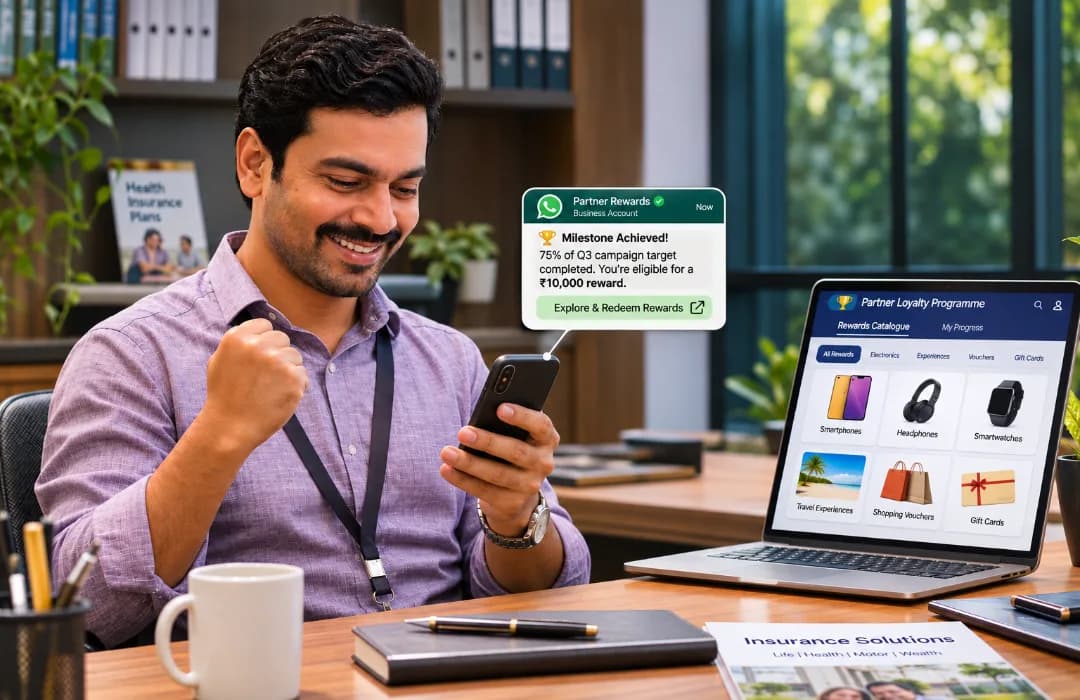
For instance, an insurance agent participating in a quarterly campaign could receive a notification upon reaching a qualifying milestone, along with a secure link to view eligible transactions, progress against targets and any remaining requirements.
Similarly, a DSA waiting for their incentive approval could receive a status update instead of repeatedly contacting the regional sales manager. However, the communication must clearly distinguish between earned, validated, approved and payable incentives. A recorded transaction may still be subject to verification, cancellation or other scheme conditions, so provisional earnings should never be presented as confirmed amounts.
A well-structured channel partner rewards program should communicate these statuses clearly at every stage. This can reduce disputes over incentive calculations, minimize unnecessary follow-ups and give partners greater confidence that their earnings are being tracked and processed fairly.
For a broader perspective, read Is Your Channel Loyalty Program Building Loyalty or Just Filling Wallets?
Why Relevance Matters More Than Message Frequency
Sending more messages does not necessarily improve partner engagement. A DSA receiving generic campaign reminders every week may eventually overlook important updates, while a timely notification about an approaching incentive milestone could prompt immediate action.
Financial institutions can make communication more relevant by segmenting partners according to their category, product eligibility, geography, preferred language and performance. However, segmentation should rely on verified partner records and actual program eligibility to ensure that messages reach the right recipients with accurate information.
Consider three situations:
A newly onboarded DSA in a Tier 3 city may benefit from onboarding instructions, documentation requirements and product-specific campaign information in their preferred language.
An established insurance agent may find renewal campaign updates, milestone notifications and incentive approval alerts more relevant to their ongoing business.
A distributor managing multiple branches may require consolidated performance summaries and notifications about pending approvals or exceptions requiring attention.
Message timing should reflect the partner's actual circumstances. Deadline reminders should reach eligible partners with sufficient time to act, milestone alerts should follow verified achievements, and changes to campaign eligibility should be communicated promptly to affected partners.
Institutions should also distinguish promotional messages from operational notifications. Partners should be able to select their preferred communication categories and opt out of optional messages through clearly defined mechanisms, with these preferences recorded centrally and applied to subsequent communications.
For channel leaders, the objective is to ensure that every message serves a clear purpose, whether helping partners understand their eligibility, take timely action or resolve an outstanding issue.
What Makes a WhatsApp Loyalty Program Work Behind the Scenes?
WhatsApp serves as the communication channel through which partners receive campaign updates, incentive notifications and reward information. However, eligibility checks, incentive calculations, transaction validations and reward approvals must be managed by the underlying systems supporting the program.
These systems ensure that the information communicated to partners reflects verified transactions, applicable scheme rules and approved incentive statuses.
An effective WhatsApp loyalty program requires integration with several underlying systems. Partner master data provides verified identity and contact details, while CRM or distribution management systems maintain partner relationships and activity records. Campaign management systems define eligibility criteria, targets and scheme rules, while incentive engines calculate qualifying achievements and validate earnings. Rewards platforms manage approved reward issuance, redemption and fulfillment, ensuring that partners receive accurate updates at each stage.
Consider how an incentive milestone notification should work:
A qualifying business transaction enters the institution's authorized system.
The incentive engine checks partner eligibility, campaign rules, transaction status and applicable limits.
The system calculates or updates the relevant milestone and records its validation status.
An approved notification is triggered using the partner's verified contact details and communication preferences.
The partner receives the update and can access further details through a secure interface.
The workflow must also deal with exceptions.
What if a transaction is reversed after a milestone has been notified?
What if the partner disputes the calculation or changes their registered mobile number?
Who goes to approve the corrected incentive amount and how is the revised status then communicated?
These are important questions, as the reliability of a WhatsApp notification is entirely dependent on the accuracy of the information that triggers it. A channel loyalty platform with automated rule validation, approval workflows and traceable records can provide the operational underpinning for that type of communication.
Could your partner communication work harder?
Explore connected engagement and incentive workflows.
What About Data Privacy, Consent and Compliance?
WhatsApp-based engagement requires institutions to consider how partner information is collected, accessed, processed and protected. India's Digital Personal Data Protection Act, 2023 and DPDP Rules, 2025 establish a regulatory framework for processing digital personal data. However, the provisions are being implemented in phases, with different requirements becoming enforceable according to their notified commencement dates. Banks, NBFCs and insurers should therefore assess which obligations currently apply and prepare for upcoming compliance requirements.
The WhatsApp Business Messaging Policy also establishes requirements for business communications, including user consent, messaging practices and opt-out mechanisms. BFSI institutions should distinguish promotional messages, such as new campaign announcements and incentive offers, from operational notifications concerning enrollment status, verified achievements, incentive approvals and reward fulfillment. This distinction helps institutions apply appropriate messaging controls, manage partner preferences and ensure that communication remains relevant and compliant.
For BFSI organizations, four controls deserve particular attention:
Consent and preferences: Record partner opt-ins through onboarding forms, registration portals or other approved mechanisms, capturing the communication purpose, consent date and source. Provide clear opt-out instructions and ensure withdrawal requests are reflected in a centralized preference record. Partners should also be able to update their preferred message categories, with changes applied to future communications.
Information security: Avoid sharing sensitive customer information, complete account identifiers or confidential financial details directly in WhatsApp messages. Where partners need access to detailed transaction records, incentive calculations or payout information, provide secure links to authenticated systems with appropriate access controls.
Access and authentication: Provide access to detailed incentive calculations, transaction records and payout information through authenticated links or secure interfaces. Apply role-based permissions to ensure partners can view only the information they are authorized to access, based on their identity, partner category and assigned responsibilities.
Communication governance: Establish approved message templates, frequency limits and defined retention policies for communication records. Maintain auditable logs of message delivery, consent changes and relevant partner interactions, in line with applicable regulatory requirements. Assign clear responsibilities and escalation timelines for handling partner complaints, disputed notifications and communication failures.
Applicable RBI and IRDAI requirements must also be considered. For example, the RBI's directions on outsourcing IT services address service-provider oversight, information confidentiality and risk management for covered arrangements.
The practical lesson is straightforward: communication convenience should never come at the expense of information security or regulatory accountability. Legal, compliance and information security teams should review the proposed workflows before implementation.
How Should Institutions Measure WhatsApp Engagement?
Message delivery and read rates provide useful information, but they reveal little about whether communication is improving the partner experience. A more meaningful approach is to measure engagement at three levels.
Measurement Area | Relevant KPIs | What it Reveals |
Communication effectiveness | Opt-in rate: Consenting partners ÷ eligible partners × 100. Delivery rate: Delivered messages ÷ sent messages × 100. Read rate: Read messages ÷ delivered messages × 100, where supported and available. Response rate: Partners responding ÷ partners successfully reached × 100. | Whether communications reach partners and generate engagement |
Program participation | Enrollment rate: Enrolled partners ÷ eligible partners × 100. Active partner ratio: Partners recording at least one qualifying activity during the measurement period ÷ enrolled partners × 100. Milestone completion rate: Participating partners achieving a defined campaign milestone ÷ participating partners eligible for that milestone × 100. | Whether eligible partners participate and progress toward campaign objectives |
Operational performance | Incentive query volume: Number of incentive-related inquiries during a defined period. Payout turnaround time: Average time between final incentive approval and completed payout. Reward redemption rate: Redeemed rewards ÷ issued redeemable rewards × 100. | Whether incentive communication and administration are becoming more efficient |
These metrics should be interpreted together and analyzed across regions, partner categories and campaigns to identify opportunities for improvement. For example, a high delivery rate but low response rate for messages requiring action may indicate that the communication lacks relevance or a clear next step. Similarly, high read rates accompanied by low campaign participation could suggest that the incentive scheme is unattractive or difficult to understand. Conversely, fewer incentive-related inquiries alongside stable participation may indicate that proactive notifications are addressing common partner questions.
Importantly, increased sales should not automatically be attributed to WhatsApp engagement. Product demand, incentive attractiveness, market conditions and partner relationships also influence commercial performance.
For additional insights, explore Transforming Channel Loyalty Programs with Data-Driven Insights.
Where Zaggle Fits into the Picture
For banks, NBFCs and insurers, WhatsApp engagement becomes more meaningful when it connects with a structured channel partner rewards program. Zaggle's channel loyalty platform brings together scheme configuration, partner onboarding, performance-linked incentive tracking, automated validations, approvals and digital reward fulfillment. Its WhatsApp-first servicing capabilities and mobile interfaces are designed to make relevant program information more accessible to partners.
Consider a bank managing multiple incentive schemes across different DSA categories. Centralized scheme rules determine which partners are eligible, which transactions qualify and how achievements are calculated. Once the relevant data is validated, connected communication workflows can send partners accurate updates on milestone achievements, incentive approval status and reward fulfillment. This ensures that notifications reflect verified program information rather than provisional or outdated calculations.
For channel sales and marketing teams, this can improve program visibility and reduce routine follow-ups. Finance and compliance teams can benefit from structured approval processes, reporting and traceable incentive records. The larger opportunity is to make partner engagement more consistent without creating additional administrative complexity.
Want to simplify partner engagement and incentive management?
See how Zaggle connects your channel programs.
Conclusion: Better Communication Can Strengthen Partner Relationships
A WhatsApp-based partner engagement program can make campaign communication, incentive information and reward updates more accessible to DSAs, agents and distributors. However, its effectiveness depends on relevant messaging, reliable program data, secure integrations and appropriate governance.
As BFSI distribution networks expand, timely communication and accurate incentive information will become increasingly important to partner engagement. WhatsApp can support these priorities when integrated with a structured channel loyalty platform rather than used as a standalone communication channel. For channel leaders, the opportunity lies in keeping partners informed about campaign requirements, verified achievements and reward status, while reducing unnecessary follow-ups and improving confidence in the incentive program.
Frequently Asked Questions
Can a WhatsApp loyalty program work without a dedicated mobile app?
Yes. WhatsApp can deliver campaign announcements, onboarding reminders, milestone notifications and reward updates without requiring partners to install another application. However, activities involving sensitive information, detailed performance reports or dispute resolution may still require authenticated portals. Institutions should evaluate which interactions can be completed through messaging and which require additional security controls.
What is the difference between WhatsApp groups and enterprise WhatsApp engagement?
WhatsApp groups are useful for informal communication, but enterprise engagement requires more structured controls. The WhatsApp Business Platform can support approved message templates, automated notifications and integration with partner management systems. It also enables institutions to manage communication according to partner eligibility, preferences and business events rather than relying on manual messages circulated through groups.
Can DSAs track incentive earnings through WhatsApp?
DSAs can receive incentive-related notifications through WhatsApp when the institution's messaging setup is integrated with an authorized incentive management system. Updates may include qualifying achievements, milestone progress and approval status. Institutions should distinguish provisional earnings from validated and payable incentives, particularly when transaction reversals, campaign conditions or approval requirements can affect the final amount.
How can banks prevent excessive WhatsApp messages to partners?
Banks can set message frequency limits, prioritize important notifications and allow partners to manage their communication preferences. Routine progress updates can be consolidated, while critical eligibility changes or deadline reminders may require immediate communication. Monitoring opt-out rates, partner complaints and response patterns can help banks identify excessive messaging and adjust communication frequency to maintain relevance and engagement.
Can WhatsApp support multilingual communication across Tier 2 and Tier 3 markets?
Yes. Institutions can create approved message templates in regional languages and associate language preferences with individual partner records. This can make onboarding instructions, campaign conditions and reward information easier to understand. However, translations should be reviewed carefully to ensure that financial terminology, eligibility requirements and deadlines retain their intended meaning.
What happens when a partner disputes an incentive calculation?
WhatsApp can provide an entry point for raising a query, but the dispute should be resolved through a structured workflow. The institution should review qualifying transactions, campaign rules, approval records and relevant exceptions. A designated team should manage the case, maintain an audit trail and communicate the outcome through an authorized channel.
How should institutions distinguish commissions from loyalty rewards?
Commissions typically arise from contractual distribution arrangements, while additional incentives or loyalty rewards may be linked to specific promotional schemes. Their accounting and tax treatment can differ. Institutions should classify each payment correctly and assess applicable obligations, including Section 194R where relevant, in consultation with their finance, tax and legal teams.
How long does it take to implement WhatsApp-first partner engagement?
Implementation timelines depend on existing technology, partner data quality, approval processes and the intended scope. A limited campaign-notification pilot may be simpler than a fully integrated incentive tracking and reward servicing program. Institutions should assess consent records, system integrations, messaging approvals, exception workflows and security requirements before determining a realistic rollout schedule.
Is WhatsApp secure for communicating incentive and partner information?
WhatsApp can be used for incentive and partner communications when supported by appropriate security and access controls. Institutions can share campaign updates, milestone notifications and reward statuses through WhatsApp, while directing partners to authenticated platforms for sensitive information such as transaction-level earnings, detailed incentive calculations and payout records. Secure system integration, role-based access, consent management and compliance with applicable data protection requirements are essential to protecting partner information.
Zaggle Admin
Expert contributor and editor at the Zaggle Knowledge Hub, specializing in corporate spend management, expense compliance, and B2B fintech solutions.
In This Article
You May Also Like
Channel Partner Loyalty for Banks, NBFCs and Insurers: A Complete Guide
Posted on : Nov 11, 2026

Channel Loyalty for India's Building Materials Brands: A Complete Playbook
Posted on : Sep 23, 2026
The Complete Guide to Channel Partner Loyalty in India
Posted on : Sep 16, 2026