
7 Proven Ways Medium and Large Enterprises Can Strengthen Their Procure to Pay Cycle

Summary
A streamlined procure-to-pay cycle reduces friction, strengthens financial controls, and gives enterprises the visibility they need to manage spending confidently. This blog examines seven practical and focused methods to streamline procure-to-pay (P2P) workflows and enhance compliance.
Why P2P Efficiency Is Becoming a Boardroom Priority
For many Indian enterprises, the procure-to-pay workflow still has small gaps that create considerable consequences. A missing approval slows down purchasing. A delayed goods receipt note can lead to disputes with vendors. A mismatched invoice interrupts cash flow planning. These are not isolated issues. All of these factors contribute to the risk associated with procurement. According to a 2023 Deloitte Global CPO survey, 43% of CPOs cited that overall procurement risk had increased significantly as compared to 20% in the 2021 study.
When finance teams look deeper, they often find that the P2P cycle is not broken. It is burdened with legacy practices. Manual requisitions, scattered documents, email-based approvals, and unstructured vendor communication keep the cycle functional but not scalable. This creates an environment where even experienced teams struggle to maintain accuracy, speed, and compliance simultaneously.
Across many enterprises, finance heads are evaluating P2P automation platforms not as a technology upgrade but as a financial strategy. A well-designed system integrates the entire journey of requisition, purchase order, goods receipt, invoice processing, and payment into a single, controlled process. Solutions like Zaggle have become familiar to teams who want to unify procurement and accounts payable without overhauling their entire structure.
The following seven methods are based on common challenges observed across mid-to-large Indian enterprises and reflect practices that modern P2P solutions make possible.
1. Create Standard Requisition Templates That Reduce Back and Forth
One of the most significant sources of P2P delays is the presence of incomplete or inconsistent requisitions. When teams submit free-form requests, procurement often needs multiple clarifications. This slows down vendor selection and PO creation. Standard templates ensure every request includes quantity, specifications, timelines, linked budgets, and justification.
2. Adopt an Approval Matrix That Prevents Unnecessary Escalations
Many Indian enterprises rely on email approvals or informal routing, which can lead to skipped approvals or unnecessary escalations. A clear delegation of authority framework enables each department to route approvals to the appropriate level based on the value, category, or type of purchase. This keeps audit trails clean and improves turnaround time. Modern P2P automation tools support configurable approval workflows, making routing predictable and well-documented.
3. Introduce PO Backing to Strengthen Controls
Procure-to-pay cycles work best when purchase order discipline is enforced. Without a PO, teams often proceed with a vendor based on urgency, which later complicates invoice matching. PO-backed purchases create accountability, drive budget control, and support a clean audit trail. They also ensure the reliability of the three-way matching process.
If you want to explore how a lack of tighter controls can cause compliance issues in your P2P process, read here.
4. Digitize Goods Receipt and Vendor Acknowledgement
A common challenge in India is the delay between the actual receipt of goods and the documentation of receipt. When GRNs are recorded late, invoices cannot be processed on time, creating payment delays and vendor dissatisfaction. A digital workflow enables teams to acknowledge deliveries in real-time, attach proof of delivery, and route it back to procurement and finance instantly.
Manual GRNs and email approvals slow everything down.
Discover how structured workflows keep teams moving forward.
Streamline Now
5. Automate Invoice Matching to Avoid Reconciliation Delays
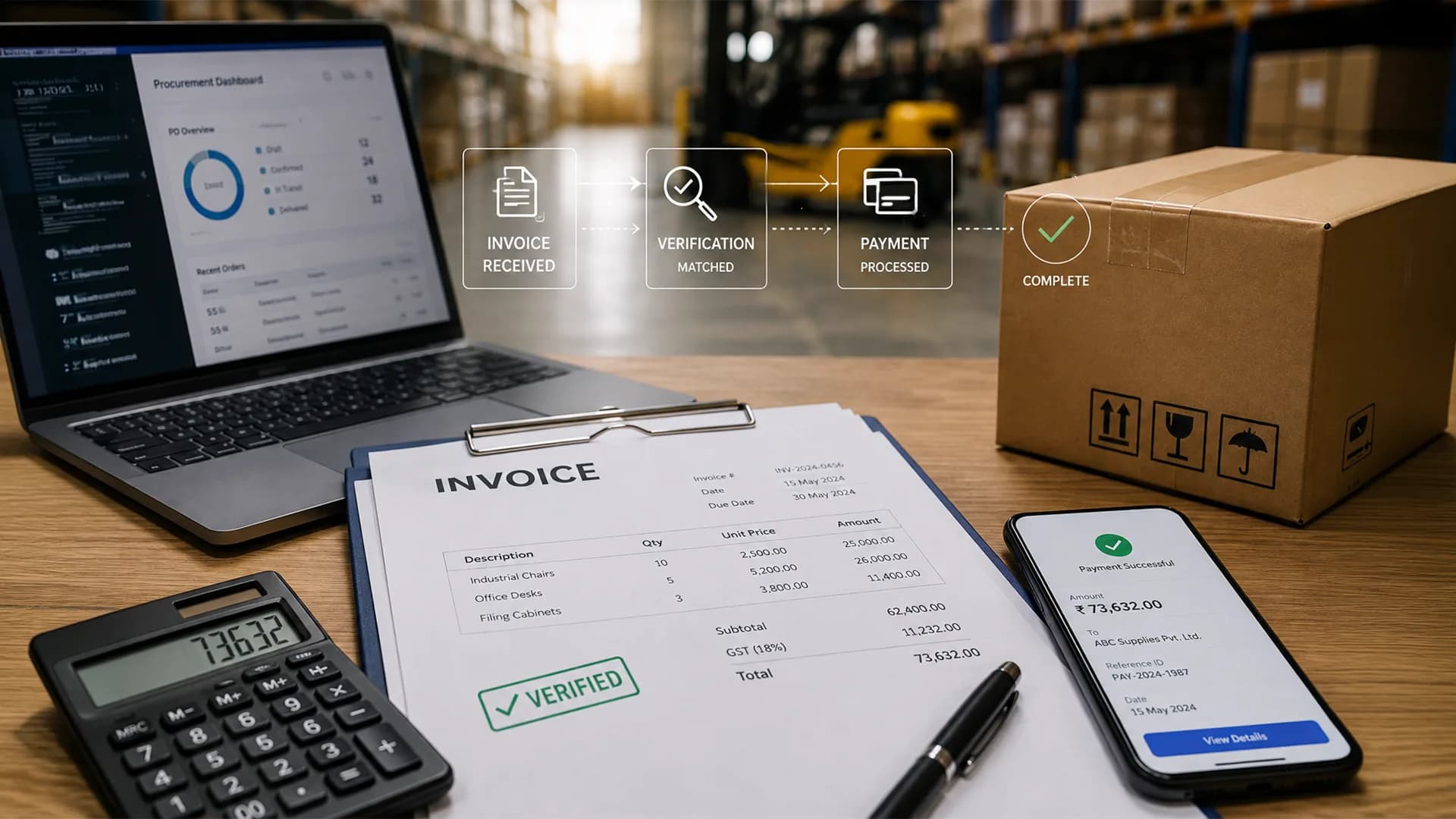
Three-way matching between PO, GRN, and invoice is one of the most time-consuming steps when done manually. Automated invoice capture, digital matching, and exception handling significantly reduce the effort required for reconciliation. This also protects enterprises from duplicate or non-compliant invoices slipping through.
6. Use Vendor Communication Portals to Reduce Follow-Ups
A significant portion of procurement effort is dedicated to managing vendor communication. Clarifying PO status, confirming delivery updates, sharing invoice details, or resolving disputes often requires repeated emails. A vendor portal centralizes communication, improves transparency, and ensures all documents are exchanged in one place. Finance teams benefit from fewer follow-ups and faster invoice closure.
Vendor follow-ups taking too much time?
Learn how unified P2P systems improve visibility.
Drive Efficiency Now
7. Leverage Analytics to Identify Bottlenecks Early
Every organization has its own P2P patterns. Some departments raise incomplete requisitions. Some approvers take longer than others. Some vendor invoices frequently require correction. Analytics enable finance leaders to monitor cycle times, identify recurring bottlenecks, and implement targeted solutions. Modern solutions, such as Zaggle, offer granular insights that simplify forecasting, vendor performance analysis, and policy compliance evaluation.
How These Methods Align with Modern P2P Platforms
Enterprises adopting P2P automation often see that these seven techniques become more straightforward to implement when the procurement cycle runs on a single platform. With features like automated workflows, PO creation, invoice processing, digital GRNs, vendor collaboration, and analytics, solutions such as Zaggle help organizations build predictable, compliant, and transparent purchasing experiences. The platform’s DOA engine and configurable routing options allow finance leaders to maintain strong controls without slowing down operations.
Disconnected procurement and AP create hidden gaps.
Explore how integration strengthens control.
Improve Control Now
Conclusion
A streamlined procure-to-pay cycle is no longer a process improvement exercise. It is a strategic enabler of financial discipline, supplier trust, and operational accuracy. By applying these seven methods, enterprises can reduce friction, standardize their procurement cycle, and position themselves for stronger cash flow outcomes. With the proper digital foundation, organizations today can create workflows that are fast, compliant, and scalable.
Zaggle Admin
Expert contributor and editor at the Zaggle Knowledge Hub, specializing in corporate spend management, expense compliance, and B2B fintech solutions.
In This Article
You May Also Like

Why Procurement Approvals Take So Long (And How Workflow Automation Fixes It)
Posted on : Aug 21, 2026
What is Procurement? The Ultimate Guide for Modern Enterprises
Posted on : Aug 14, 2026

5 Best Practices to Cut Accounts Payable Processing Time
Posted on : Jul 22, 2026