
Digital Gift Cards vs. Physical Gifts: Which Delivers a Better Employee Experience This Diwali?
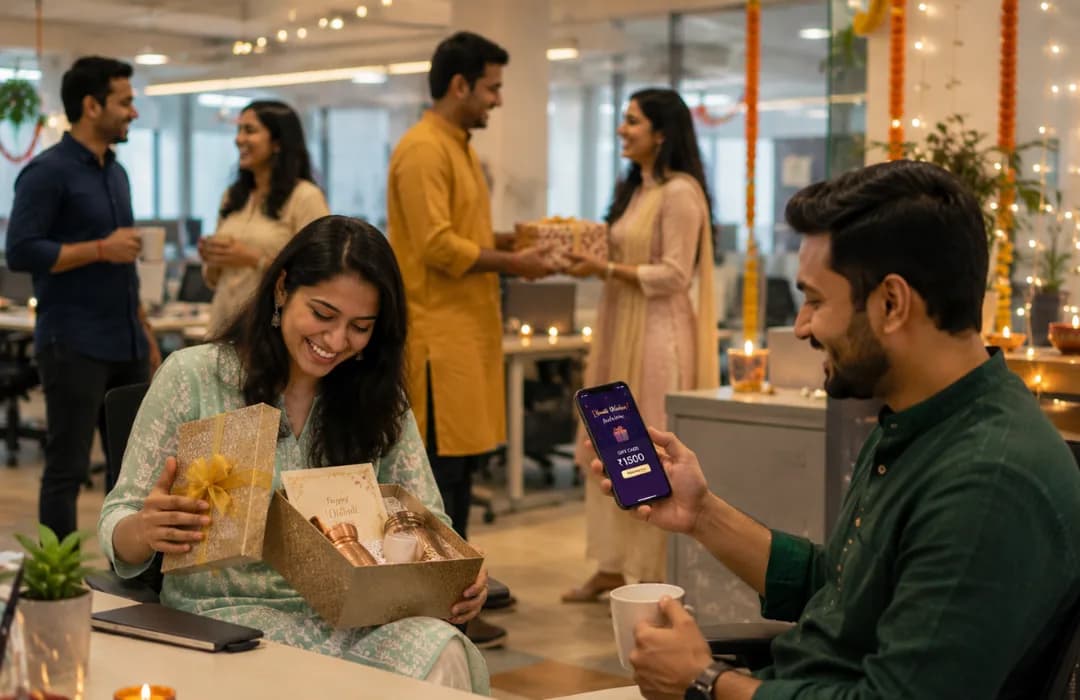
Summary: Digital gift cards or physical Diwali gifts? For employers in India, the choice comes down to more than convenience. We compare both across employee choice, personalization, scalability, and administration to see which creates a better gifting experience.
Choosing a Diwali Gift Was Easier When Everyone Wanted the Same Thing
There was a time when Diwali gifts for employees usually meant a box of sweets or dry fruits, and that comfortably ticked the festive gifting box. Today, corporate Diwali gifting has a much tougher audience: five generations at work, employees across cities and smaller towns, remote teams, field employees, and people with very different lifestyles and preferences.
That is where digital gift cards for employees in India become an interesting alternative to traditional gifts. But does the convenience of digital automatically make it a better Diwali gift? Not necessarily. There is employee choice and the actual gifting experience to consider, but also accessibility, administration, scalability, sustainability, and what employers can learn once the gifts have been distributed. We’ll look at both options through each of these lenses.
Key Messages
Physical gifts still have the edge on festive appeal, but finding one gift that feels relevant to a diverse workforce is getting harder.
Digital gift cards make employee choice easier, provided the options are relevant and redemption is simple.
At scale, the difference goes beyond gifting. Digital rewards can simplify distribution, approvals, budget control, and tracking.
There is no universal winner. The better choice depends on what employees value, how your workforce is distributed, and the experience you want the gift to create.
Physical Gifts Still Win the Unboxing Moment
Let's give physical gifts the attention they deserve. A Diwali hamper arriving at someone's desk or home feels like a gift. There is anticipation in opening it. You can share it with the family. Even the packaging can add to the occasion. Digital rewards have to work harder to create that feeling.
There is plenty of room to make physical gifting more thoughtful too. A company could choose products from local artisans, opt for recycled or reusable packaging, include regional specialties, or build hampers around food, wellness, home, or family.
The challenge is that even a thoughtfully chosen gift can miss the mark. One employee loves the gourmet hamper. Another cannot consume half of it. Someone already owns the appliance being gifted. Another would have preferred something for their children. The larger and more diverse the workforce, the harder it becomes to find one physical gift that feels equally relevant to everyone.
Digital Gift Cards Put One Decision Back Where It Belongs - With the Employee
This is where e-gift cards for employees can offer an advantage. Instead of HR trying to figure out what thousands of different people might like, employees can choose themselves.
Someone may use the reward for Diwali clothes. Someone else may choose groceries, electronics, dining, travel, home products, or something for the family. The monetary value may be identical, but the value the employee experiences can differ greatly. Choice, however, needs to be genuine.
A voucher restricted to one retailer may simply replace one standardized gift with another. Broader catalogs, multiple brands and categories, or flexible digital rewards give employees more room to choose something that fits their lives. That distinction matters when organizations talk about personalization. Personalization does not always require HR to know exactly what every employee wants. Sometimes, it simply means giving people enough choice to decide for themselves.
The same question comes up when employers are deciding between festive reward formats. If employee preference is the starting point, our guide to Diwali bonus vs. gift voucher: what employees value more in 2026 takes that discussion a little further.
What Should You Check Before Choosing a Digital Gifting Platform?
Digital gifting sounds wonderfully simple on paper. Upload an employee list, select the reward, send it, and it is done. Except the experience at the employee’s end matters just as much as the convenience at HR’s end. Before choosing a digital gifting platform for employees, it is worth checking a few practical things:
Easy access: Can employees receive and access their rewards easily on a mobile phone?
Simple redemption: Are the instructions clear, without too many steps or logins?
Relevant choices: Are useful brands and categories available across the locations where employees live?
Room for exceptions: What happens if an employee changes their mobile number, deletes the message, or cannot access the reward?
Employee support: Is help easily available if a voucher does not arrive or redemption does not work?
These details become even more important when online Diwali gifting for employees spans offices, remote teams, plants, warehouses, branches, and field locations. A digital reward that is easy to distribute but difficult to redeem has only solved half the problem.
At Enterprise Scale, the Gifting Conversation Changes
For a smaller organization, physical gifting can be relatively manageable. At enterprise scale, the story changes. Procurement has to finalize vendors. Budgets need approvals. Gifts have to be packed, transported, stored, distributed, and sometimes re-dispatched. Employee addresses need to be accurate. Someone has to deal with damaged packages, employees on leave, remote workers, and deliveries that never quite reach where they were supposed to. Multiply those exceptions across thousands of employees, and Diwali gifting becomes a sizable operation. Digital gifting removes many of those physical steps.
A digital gifting platform in India lets organizations define eligibility, set budget limits, establish approval workflows, schedule distribution, and maintain records of what was issued and to whom. This is where the conversation moves beyond gift cards themselves. For HR and Finance, the advantage is not just easier distribution. It is being able to manage Diwali gifting at scale without losing visibility over budgets, approvals, and who received what.
Taking Diwali gifts from hundreds of employees to thousands?
Simplify budgets, approvals, and digital reward distribution.
Request a demo.
Digital vs. Physical Gifting: How Do They Really Compare?
What Matters | Digital Gift Cards | Physical Gifts |
|---|---|---|
Employee choice | High when multiple brands and categories are available | Depends on how well the gift matches individual preferences |
Festive experience | Needs thoughtful presentation and personalization | Naturally tangible and celebratory |
Distribution | Easier across locations and remote teams | Requires procurement and logistics |
Speed | Can support near-instant delivery | Depends on inventory and delivery |
Personalization | Can offer choice by category, value or employee group | Can be customized through products and packaging |
Administration | Can automate eligibility, approvals and distribution | Usually requires more manual coordination |
Measurement | Redemption and utilization can be tracked | Limited visibility after distribution |
Sustainability | No physical packaging or transportation | Can incorporate sustainable products and packaging |
The table makes digital look efficient. But efficiency alone should never decide what employees receive for Diwali. Festive gifting is still about appreciation.
Don't Stop Measuring Once the Gifts Are Delivered
This is one area where digital rewards can tell employers something physical gifts often cannot.
What happened after the gift was sent? Organizations can look at a few simple indicators:
Redemption rate: Did employees actually use their rewards?
Utilization: How much of the issued value was used?
Category performance: What did employees choose?
Regional trends: Did preferences differ across locations?
Employee participation: How many people engaged with the reward?
Satisfaction: Did employees find the experience useful and easy?
Nobody wants Diwali gifting to become another dashboard. That isn't the point. The value lies in what these numbers can tell you before next Diwali. Perhaps employees in one region consistently prefer shopping and household categories while another location shows stronger interest in travel or dining.
Perhaps redemption is lower in one employee group because the available choices are less relevant. Maybe satisfaction is high, but utilization is low because employees simply need more time to redeem. Those are useful signals, especially when you act on them.
Start with what employees actually redeemed and preferred. Look for gaps across categories, locations, or employee groups. Use those patterns to adjust the reward mix, remove choices that see little interest, and add options employees are more likely to value.
That way, next year’s gifting conversation doesn’t have to begin with, “What did we give last year?” It can begin with a much more useful question: “What did people actually value last year, and what can we do better this time?”
And employee preferences are only one part of how festive rewards are changing. The corporate Diwali gifting trends Indian companies are following in 2026 offer a wider view of where gifting strategies are headed.
Maybe Digital vs. Physical Is the Wrong Debate
There is no rule saying an organization has to choose one camp. A physical gift can create a festive moment, while a digital reward offers choice. A small box of sweets or a thoughtfully sourced product can pair well with a flexible voucher. Some employee groups may prefer digital rewards, while others may respond better to physical gifting. Even within digital gifting, there is room to make the experience more personal. A festive message in an employee’s preferred language can feel warmer than a standard company-wide greeting. Similarly, offering reward choices that are actually available where employees live makes the gift far more useful. Personalization could also extend to different reward catalogs or options for different employee groups.
The goal isn't to add complexity. It is simply to recognize that a workforce of thousands of different people does not suddenly develop identical preferences because Diwali arrives. The more diverse the workforce, the more useful it becomes to give employees some room to choose what feels relevant to them.
The Better Gift Is the One Employees Can Make Their Own
For organizations considering digital gift cards for employees in India, the appeal goes beyond convenient delivery. They can offer employees greater choice, easier access, and a more flexible gifting experience, while giving employers better visibility into what people actually value.
Physical gifts still have something digital rewards cannot fully replicate: the joy of receiving and opening a Diwali gift. Digital rewards, on the other hand, can make choice and scale easier to manage. The better Diwali gifting strategy brings those two realities together and asks a simple question: Will employees genuinely enjoy receiving this?
Want to give employees more say in what they receive this Diwali?
Bring employee choice and enterprise-scale gifting together with Zaggle.
Request a demo.
Frequently Asked Questions
1. Are digital gift cards better than physical Diwali gifts for employees?
It depends on what the organization wants the gift to achieve. Digital gift cards offer employee choice, easier distribution, and greater flexibility, especially for large, geographically dispersed teams. Physical gifts offer tangibility and can create a stronger festive moment. The better option depends on workforce preferences, accessibility, budget, and the experience the organization wants employees to have.
2. What are the benefits of digital gift cards for employees in India?
Digital gift cards can be distributed across locations without the logistics of physical delivery. Companies should still allow time to verify employee details, complete approvals, and ensure employees know how to access and redeem their rewards.
3. How do employees redeem digital Diwali gift cards?
Employees typically receive their digital gift card by email, SMS, or through a rewards platform. Depending on the program, they can then use it with eligible brands or categories. Employers should ensure the redemption steps are simple, clearly communicated, and easy to access on mobile devices.
4. Can digital Diwali gifting still feel personal?
Yes, as long as personalization goes beyond adding an employee's name to a message. Organizations can offer multiple categories, location-relevant choices, multilingual greetings, or different reward options for different employee groups. Giving employees the freedom to choose something meaningful to them can itself be a powerful form of personalization.
5. How can companies manage Diwali gifting for employees across India?
For a geographically distributed workforce, centralized digital gifting can help companies manage employee data, eligibility, budgets, approvals, and distribution across locations. It can also provide a clearer record of rewards issued and redeemed. Just as importantly, companies should plan employee communication and support so that people know how to access and use their rewards.
6. What should HR measure after distributing digital Diwali rewards?
Useful KPIs include redemption rate, utilization, employee participation, category performance, regional preferences, and satisfaction scores. These measures can help HR understand whether employees actually used and valued the reward. More importantly, the insights can inform next year's decisions around budgets, reward choices, communication, and the overall gifting experience.
7. Are digital gifts more sustainable than physical gifts?
Digital rewards avoid physical packaging and transportation, which can reduce some of the material associated with gifting. Physical gifts can also be made more sustainable by choosing reusable products, local artisans, recycled or plantable packaging, and lower-waste options. Organizations should consider the complete gifting lifecycle rather than assuming one format is automatically sustainable.
8. Should companies combine digital and physical Diwali gifts?
They can. A hybrid approach lets organizations keep the emotional appeal of a tangible Diwali gift while giving employees more flexibility through a digital reward. For example, employees might receive a small festive hamper alongside a flexible voucher. Whether this works depends on budget, workforce preferences, logistics, and the experience the company wants to create.
9. What should companies look for in a digital gifting platform in India?
Beyond the number of available brands, companies should consider redemption ease, mobile accessibility, employee choice, geographic relevance, distribution workflows, budget controls, reporting, and support. At enterprise scale, governance also matters. The platform should make gifting easier for HR and Finance without adding unnecessary steps to the employee experience.
10. Are Diwali gifts or digital gift cards taxable for employees in India?
The tax treatment of employee gifts and rewards can depend on their value, structure, and the circumstances in which they are provided. Organizations should have their HR, Finance, and tax teams review the applicable rules and internal policies before finalizing a Diwali gifting program.
Zaggle Admin
Expert contributor and editor at the Zaggle Knowledge Hub, specializing in corporate spend management, expense compliance, and B2B fintech solutions.
In This Article
You May Also Like
15 Diwali Employee Engagement Activities That Go Beyond Gifting
Posted on : Sep 10, 2026
Top 12 Diwali Gift Ideas for Frontline and Factory Employees in 2026
Posted on : Aug 26, 2026
30 Diwali Gifts for Employees Under Rs. 5000, Rs. 2500, and Rs. 1000
Posted on : Aug 19, 2026