
Employee Device Benefits in India: The Complete Guide for HR and Finance
Summary
Employee device benefits in India offer enterprises different ways to make smartphones, laptops and tablets more accessible to employees. This guide helps HR and Finance leaders compare purchase, reimbursement and leasing models to choose the right approach for their workforce. It also covers affordability, payroll administration, tax and compliance considerations, ownership, device protection and exit policies, helping employers make informed decisions before implementing or scaling a program.
Introduction: Why Employee Device Benefits Matter
A premium smartphone costing Rs. 90,000 may be useful for an employee, but paying the full amount at once can strain personal finances. For employers, the challenge is finding a way to make such devices accessible while balancing employee choice with cost control, manageable administration and compliance requirements.
Employee device benefits can help address this challenge. Depending on the programme structure, they may support access to work-related devices, personal devices or both, subject to the employer's policy. Structured purchase or leasing arrangements can also allow eligible employees to spread payments over an agreed period.
However, not every model works the same way. HR and Finance must evaluate the financial commitment, payroll implications, tax treatment, ownership and exit obligations before deciding which approach best suits their workforce.
Key Takeaways
Choose the right model: Company-issued devices offer greater organizational control, reimbursements suit employee-funded purchases, outright purchases provide immediate ownership, and structured EPPs can offer greater payment flexibility.
Compare the total employee cost: Look beyond monthly deductions to assess the full amount payable, device ownership, protection charges and end-of-term obligations.
Verify tax and compliance implications: Tax treatment varies by arrangement and should be validated before implementation rather than assuming universal savings or exemptions.
Evaluate operational readiness: HR and Finance should assess eligibility, payroll integration, employee consent, approvals, reporting and exit settlements, with clear responsibilities across teams and providers.
What Are Employee Device Benefits?
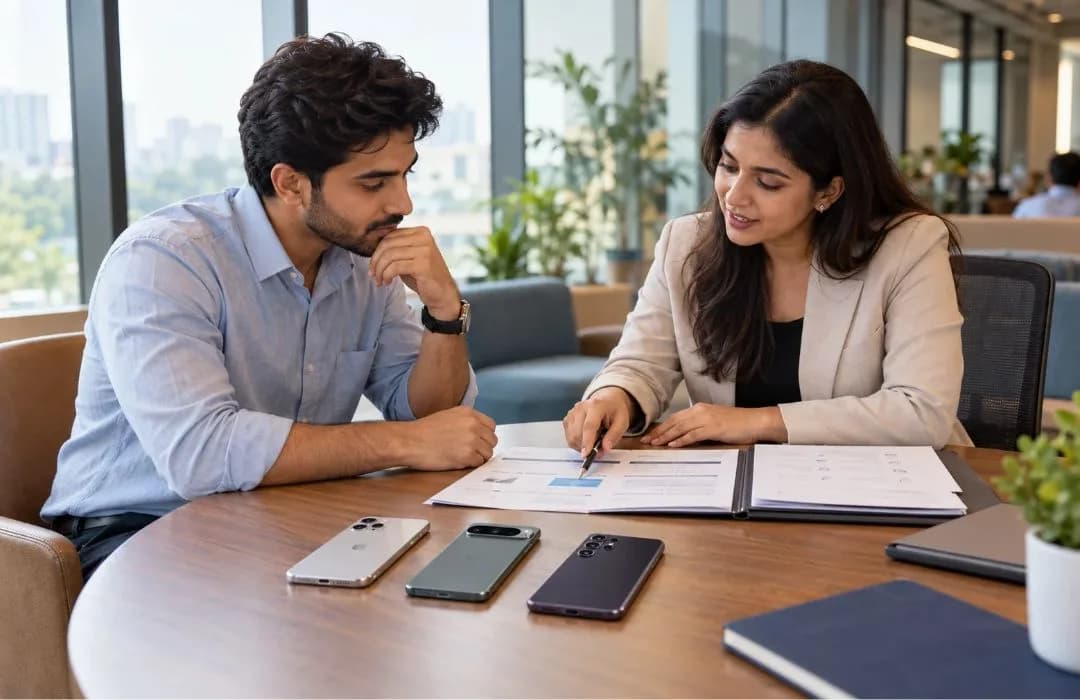
Employee device benefits are employer-facilitated arrangements that help eligible employees access smartphones, laptops, tablets and other devices under an organization's policy. These benefits generally follow four models:
Company-issued devices: The employer provides devices primarily for work use and typically retains ownership.
Reimbursement: Employees purchase eligible devices and claim an approved amount from the employer, subject to company policy.
Outright purchase: Employees buy devices directly, pay the purchase price and generally own them from the outset.
Employee Purchase Program (EPP): The employer facilitates a structured purchase or lease arrangement, potentially with payroll-linked payments. Ownership and payment terms depend on the specific program.
The distinction matters because each model involves different costs, administrative responsibilities and ownership obligations. Understanding these differences helps HR and Finance select an arrangement that meets employee needs while remaining practical for the organization.
Device Purchase, Reimbursement or Leasing: Which Model Works Best?
Different device benefit models offer varying levels of affordability, employee choice and administrative control. Understanding how each model handles payments, ownership and employee exits can help HR and Finance choose the most suitable approach.
Model | Who pays and when | Device ownership | Employee flexibility | Administration and exit implications |
Company-issued device | Employer purchases or leases the device. | Generally retained by the employer or leasing provider. | Usually limited to company-approved devices. | Higher IT and asset-management involvement. Devices typically require return or settlement upon exit. |
Reimbursement | Employee pays upfront and claims an approved amount. | Generally owned by the employee. | Choice within company policy and reimbursement limits. | Requires claim verification and approval. Exit obligations depend on policy. |
Outright employee purchase | Employee pays the full purchase price directly. | Generally transfers to the employee at purchase. | Broad choice, subject to personal budget. | Minimal employer administration. Usually no employer-related exit settlement. |
Structured lease or EPP | Employee pays under agreed terms, potentially through payroll deductions. | Depends on the purchase or lease agreement. | Choice from an eligible catalog, within approved limits. | Requires eligibility checks, approvals and payment tracking. Early exit may trigger outstanding payments or device return. |
Note: This is an operational comparison. Payment structures and ownership terms may vary by contract, and the models do not necessarily receive identical tax or accounting treatment.
The choice should begin with the employer's primary objective. Company-issued devices offer greater IT control, reimbursements allow more employee flexibility, and outright purchases provide immediate ownership. An EPP may be more suitable when the priority is to make devices affordable through structured payments while keeping administration centralized.
However, an EPP is a program framework, not a single purchase or leasing model. HR and Finance should evaluate its specific commercial terms, including total employee cost, ownership, tax and accounting treatment, and exit obligations, before implementation.
How Payroll-Linked Device Benefits Can Improve Affordability
Payroll-linked device benefits allow eligible employees to access approved devices without paying the full price upfront, where the programme offers this option. Instead, payments are spread over an agreed tenure through authorized salary deductions. This can make monthly budgeting easier, although it does not necessarily reduce the total cost of the device.
For illustration, a device priced at Rs. 90,000 divided over 24 months would mean Rs. 3,750 per month, excluding applicable charges, taxes and any end-of-term payment. Actual deductions depend on the programme terms. Before enrolling, employees should know their eligible limit, total payable amount, deduction start date, payment schedule, ownership terms and cancellation conditions.
For HR and Payroll, employee consent and accurate deduction management are essential. Clear payroll cutoffs should determine when deductions begin, particularly if device delivery is delayed. The programme should also define how missed deductions, insufficient salary and payroll discrepancies are handled, with regular reconciliation between payroll records and provider statements.
Tax treatment depends on how the device benefit is structured. An employer-provided device for use, reimbursement of an employee's purchase, and a structured lease or purchase arrangement may each have different tax implications, particularly where ownership transfers to the employee. Payroll deductions or leasing do not automatically make a device tax-exempt or guarantee tax savings. Employers should verify the applicable treatment before introducing the program.
What Employees Gain from a Structured Device Benefits Program
A structured device benefits program gives employees access to eligible smartphones, laptops, tablets, and accessories across different brands and price points. A curated catalog can include premium devices that employees might otherwise hesitate to purchase upfront. Depending on the program, flexible payment options can make these devices more affordable on a monthly basis, while coordinated delivery and access to warranty services or device protection, where offered, add convenience.
However, these benefits are meaningful only when employees understand what they are signing up for. Participation should be voluntary where the program permits, with clear information about eligibility, total costs, payroll deductions, ownership, and exit obligations. Employees should know their approved spending limit before selecting a device and have access to support for delivery, payments, and service-related questions. Transparent communication helps employees make confident decisions about whether the program meets their needs.
What HR and Finance Teams Need to Evaluate
A successful rollout requires clear responsibilities across HR, Finance, Payroll, IT, Legal, and the program provider. Before implementation, employers should establish a responsibility matrix covering eligibility, budget limits, approvals, employee consent, data privacy, accounting treatment, payroll deductions, and outstanding balances at exit. While providers can manage tasks such as device fulfillment, servicing, and reporting, the employer must retain oversight of policy decisions, financial controls, compliance, and employee obligations. Each team should also have a defined process for handling exceptions and resolving issues.
Team | Core responsibility |
HR / Rewards | Program governance, eligibility, policy communication, employee complaints, and coordination of employee exits. |
Finance | Budget controls, program economics, accounting treatment, financial reporting, exception approvals, and final settlement reconciliation. |
Payroll | Deduction authorizations, payroll cutoffs, corrections, missed deductions, unpaid leave, and final payroll adjustments. |
IT / Security | Work-device access, usage policies, security standards, and oversight of data access, retention, and deletion requirements. |
Legal / Compliance | Contracts, employee notices, applicable consent and privacy requirements, tax and regulatory review, and compliance oversight. |
Provider / Procurement | Catalog management, approval workflows, delivery, employee support, device protection, and service reporting, as defined in the contract. |
Consider a device delivered just after the monthly payroll cutoff, a canceled order for which deductions have already been initiated, or a deduction that fails because an employee's salary is insufficient. An employee leaving before completing the payment term can create another settlement challenge.
These situations require more than routine payroll processing. Finance, Payroll, HR, and the provider need a documented process to identify exceptions, reconcile payments, resolve discrepancies, and assign responsibility for outstanding amounts. Clear escalation procedures help prevent financial errors and unresolved employee complaints.
Tax, Compliance, Ownership and Exit Considerations in India
Employee device benefit programs require clarity on ownership, tax treatment and financial obligations. Under a lease, employees may use a device without owning it. Any option to transfer ownership at the end of the tenure, including applicable charges, should be clearly documented.
Tax treatment depends on the program structure. The Income-tax Act, 2025 and Income-tax Rules, 2026 contain provisions relevant to employee perquisites and asset transfers. Similarly, GST implications and input tax credit eligibility must be evaluated under the CGST Act. Employers should seek appropriate tax and accounting advice rather than assume universal exemptions or savings.
Payroll deductions must have a valid legal basis, documented employee authorization where required, and clear payment terms. Before enrollment, employees should receive information about the total payable amount, deduction schedule, ownership conditions, and applicable charges. HR, IT, and Legal should also review how personal and payroll data is collected, shared with the program provider, stored, and deleted, with appropriate privacy notices, access controls, and security safeguards.
Employee exits require separate provisions for outstanding payments, device return, and ownership transfer. The agreement should explain how any unpaid balance is calculated, whether the device must be returned, and the conditions for transferring ownership, where applicable. HR, Finance, and Payroll should ensure that the final settlement is communicated to the employee, reconciled with provider records, and handled in accordance with applicable law and contractual terms. Device protection coverage, exclusions, and claims procedures should also be disclosed upfront.
How to Evaluate an Employee Purchase Program
Choosing an EPP provider involves more than comparing device catalogs and payment options. HR and Finance should evaluate how the program works throughout the employee journey, from eligibility and device selection to payroll deductions, servicing, and final settlement.
Use the following checklist when evaluating providers:
Catalog and eligibility: Can the program accommodate approved device categories, employee spending limits, payment tenures, and contributions above eligible limits?
Enrollment and approvals: Can employees view their eligibility, total financial commitment, and ownership terms before placing an order?
Orders and delivery: How are approvals, order cancellations, refunds, delivery tracking, and returns managed?
Payroll and reporting: What processes support deduction authorizations, payroll reconciliation, missed payments, and exception reporting?
Protection and support: What warranty or protection services are available, what exclusions apply, and how are claims and employee complaints resolved?
Ownership and employee exits: How are outstanding balances, device-return obligations, ownership transfers, and final settlements handled?
Before implementation, ask providers to demonstrate these processes using practical scenarios, including canceled orders, missed deductions, protection claims, and early employee exits. Review sample contracts, employee disclosures, payroll reports, and settlement statements to verify which capabilities are supported and included in the agreed scope.
Once launched, track enrollment, approval turnaround, deduction accuracy, service resolution, and unresolved settlement cases to assess whether the program is delivering a reliable employee experience without creating unnecessary administrative work.
Planning an employee device benefits program?
Discuss your workforce and implementation requirements.
Request a Program Consultation
How Zaggle Helps Employers Manage Employee Device Benefits
At Zaggle, our Employee Purchase Program makes device access convenient for employees while giving HR and Finance a manageable process. Eligible employees can select premium smartphones, tablets, laptops and accessories without upfront payment under the applicable program terms. Digital selection, approvals, delivery coordination, payroll-linked deductions and reporting help reduce manual administration.
Three aspects are worth evaluating against your organization’s needs:
Employee savings: Savings of up to 48% may be possible in eligible circumstances, but depend on tax treatment, device selection and program structure; they are not guaranteed.
Corporate commitments: The program is designed to avoid upfront corporate investment under agreed terms. Finance should verify any liability or accounting implications in the contract.
Device protection: Available options may cover accidental damage, liquid damage and theft during the lease period, subject to policy terms, limits and exclusions.
For us, the objective is a clear experience from device selection through final settlement. Employees should understand their payments and service options; employers should have reliable approvals, records and exception handling.
Device protection should be evaluated for coverage, exclusions, claim procedures, and the responsibilities of the employer, provider, and insurer, where applicable. Zaggle's guide to device protection and a seamless employee experience explains these considerations in more detail.
What Will Shape the Future of Employee Device Benefits in India?
For Indian enterprises, the focus should be on making device benefits easier to manage at scale. Better payroll integration, digital approvals, and automated reconciliation can reduce administrative effort, while transparent employee disclosures help prevent confusion over payments and ownership.
Organizations should also prioritize reporting on program costs, device servicing, and end-of-term settlements. Clear processes for device returns, refurbishment, and disposal, where applicable, can support more effective lifecycle management.
Want to explore Zaggle’s Employee Purchase Program?
Book Your Program Demo
Conclusion: Making Device Benefits Work at Enterprise Scale
Employee device benefits can improve access to technology while strengthening an organization's overall benefits offering. However, a successful program requires more than attractive devices and flexible payments.
For enterprises, the real value lies in making these benefits accessible across a diverse workforce without adding administrative complexity or financial risk. By combining employee choice with transparent payment terms, automated payroll processes and clear ownership and exit policies, organizations can turn device benefits into a scalable, well-governed program that delivers measurable value to employees and the business.
Frequently Asked Questions About Employee Device Benefits
1. What are employee device benefits?
They are employer-facilitated arrangements that help eligible employees obtain or use smartphones, laptops and other devices. Options include company-issued equipment, reimbursement, outright purchases and structured leasing or purchase programs. Payment responsibility, ownership and administration differ by model.
2. How does an Employee Purchase Program work in India?
The employer defines eligibility, device limits, and program terms. Employees select an approved device and complete the required approvals. Depending on the arrangement, the EPP may involve an outright purchase, a structured payment plan, or leasing, with or without payroll deductions. Device fulfillment, support, ownership, and end-of-term obligations depend on the agreement.
3. What is the difference between employee device leasing and device reimbursement?
Under leasing, employees use a device for an agreed term, with payments made according to the lease agreement. Ownership may remain with the leasing provider, and employees may need to return the device or meet specified conditions to acquire it. With reimbursement, employees typically purchase and own the device upfront, then claim an eligible amount from their employer. Leasing may involve outstanding payments or return obligations at exit, while reimbursement is generally governed by company policy.
4. Can employees buy smartphones and laptops through payroll deductions?
Yes, where the employer offers an eligible payroll-linked program. Employees should see their monthly deduction, tenure, total cost and any final payment before confirming the order. Payroll deductions require appropriate authorization and must comply with applicable requirements.
5. Are employee device benefits tax-exempt in India?
Not automatically. Tax treatment depends on the device, whether it is provided for use or transferred, the program structure and the employee’s circumstances. Employers should obtain current tax advice rather than promise that every EPP or employee receives an exemption.
6. Who owns the device during and after the program?
Ownership is determined by the relevant purchase or lease agreement. In an outright purchase, the employee generally owns the device from the start. Under a lease, ownership typically remains with the designated owner during the term. Any transfer of ownership at the end of the program, including applicable conditions or payments, must be clearly stated in the agreement.
7. What happens to outstanding device deductions when an employee leaves?
Any outstanding payments must be settled according to the program agreement and applicable legal requirements. Depending on the terms, employees may be able to pay the remaining balance directly, while device return or ownership transfer may involve separate conditions. HR, Payroll, and the provider should coordinate the final calculation, communicate the obligations to the employee, and reconcile the settlement.
8. What should HR and Finance evaluate before introducing an EPP?
Review eligibility, device choice, total employee cost, deduction authorization, payroll integration, provider reporting, data privacy, protection, ownership and exit settlement. Finance should also review commercial commitments, tax treatment and accounting implications before approval.
9. What if an employee’s salary is insufficient for a deduction?
The agreement should define how unpaid leave, variable pay or other shortfalls are handled. Alternative payments or rescheduled deductions may be available only if permitted by the provider and employer policy. Payroll should communicate the process before enrollment.
10. Can an employee select a device above the approved limit?
Some employers restrict the catalog to eligible price bands; others may allow an additional employee contribution. Employees should see their approved limit and any excess amount before selecting a device. The provider’s configuration and employer policy determine what is allowed.
11. What happens to device payments during extended unpaid leave?
Payment obligations generally continue unless the agreement provides otherwise. HR and Payroll should explain whether direct payment, adjustment or another approved process applies when regular salary deductions cannot be made. Any change should be documented with the employee.
12. Who handles repairs and warranty claims?
The manufacturer, provider or protection insurer may be responsible, depending on the issue and applicable coverage. Employees should know where to raise a claim, what exclusions and deductibles apply, and how repairs or replacements are handled before they enroll.
Zaggle Admin
Expert contributor and editor at the Zaggle Knowledge Hub, specializing in corporate spend management, expense compliance, and B2B fintech solutions.
In This Article
You May Also Like

Employee Smartphone Leasing: How Teams Get Flagship Phones at Zero Upfront Cost
Posted on : Oct 23, 2026

How Employee Device Leasing Works in India: Selection, Payroll and Ownership
Posted on : Oct 14, 2026
What Is an Employee Purchase Program? The Complete 2026 Guide for Indian Employers
Posted on : Oct 7, 2026