
How Retail Firms Can Use Spend Data to Negotiate Better Vendor Terms
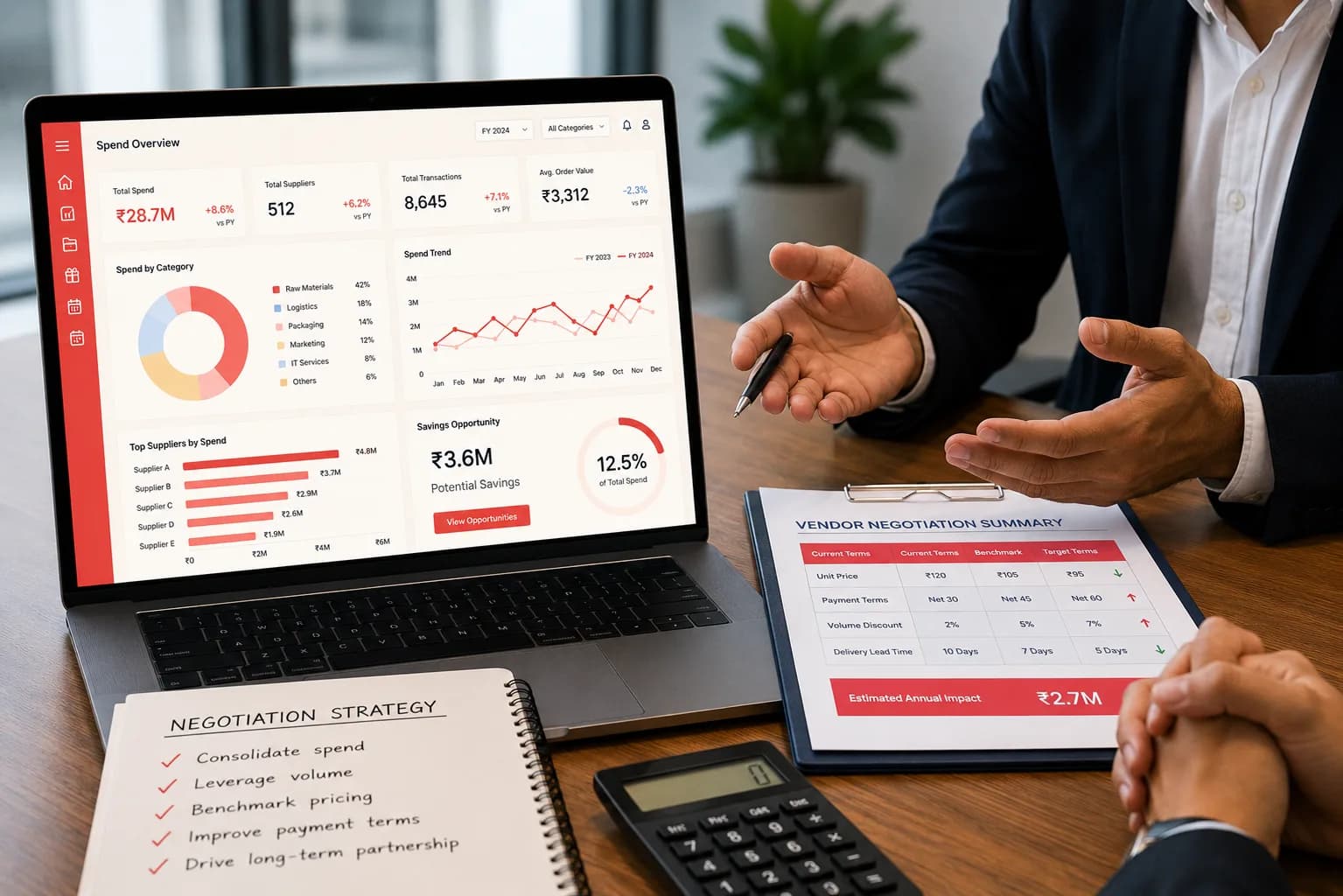
Vendors play a crucial role in the agility of retail enterprises. A strong, profitable partnership with vendors allows retailers to boost efficiency and meet customer expectations. Take a scenario in which the procurement team of a mid-sized multi-location apparel retailer reviews vendor invoices that frequently exceed budgeted amounts.
This applies to vendors providing logistics, IT solutions, and packaging materials. Locked-in terms from earlier agreements, such as elevated unit prices and inflexible delivery windows, contribute to these overruns. This was especially critical when margins tightened ahead of peak seasons.
Without access to consolidated historical spend data, negotiations with vendors relied on incomplete information. This led to agreements that did not fully reflect the retailer's purchasing power and overall retail spend management.
This challenge is widespread in retail, where spend data is often siloed across suppliers, product categories, and locations, limiting visibility for procurement decisions. The global retail market, valued at $30.6 trillion in sales in 2025, continues to face supply chain complexities, including material price fluctuations and competitive sourcing.
Retailers without aggregated insights into total spend, transaction patterns, or vendor performance miss opportunities for:
Discounts
Bulk vendor contracts
Better payment terms
Incentives tied to volume
Spend data analytics addresses this by enabling firms to aggregate and analyse procurement data systematically. This involves effective procurement data analysis, categorising expenses, identifying consolidation opportunities, and comparing against industry benchmarks to strengthen negotiation positions.
For instance, teams can highlight high-volume purchases to secure rebates or renegotiate with low-compliance vendors. Such practices typically yield cost reductions of 5-15% while building more efficient supplier relationships.
Challenges in Vendor Negotiations for Multi-Branch Retailers
For retailers who operate in multiple locations, vendor negotiations go beyond mere price haggling. Branches often face unique demands from local markets, state regulations, and customer behaviours. However, procurement must advance enterprise-wide objectives and strong retail spend management practices.
Without unified data on spend patterns and vendor performance, isolated negotiations can erode a retail brand’s leverage. It is no wonder that this leads to inefficiencies that both raise costs and strain supply chains. These challenges manifest in several key areas:
Fragmented Spend Visibility
Data silos across branches hinder the aggregation of total purchase volumes, weakening the retailer's position to demand volume-based discounts or extended payment terms. A Gartner report notes that organisations with real-time spend visibility are 22.4% more likely to meet procurement targets.
Inconsistent Vendor Performance Tracking
Monitoring delivery timelines, quality standards, and compliance becomes arduous when vendors supply multiple sites with varying lead times and minimum order quantities. Delayed shipments alone can trigger stockouts and lost sales, with a 2024 McKinsey analysis indicating that effective vendor management could improve on-time delivery rates by 25%.
Alignment Gaps
Miscommunications between central procurement and branch-level operations often lead to mismatched expectations. This erodes trust and complicates renegotiations, leading to inefficiencies that may often impact customer satisfaction.
Risk Exposure from Diverse Supply Chains
Fluctuating market conditions, different regulations, and global issues increase risks, especially when retailers try to negotiate the same contracts for branches in different areas. Retailers managing multiple supply chains are more likely to face disruptions that can lead to inventory problems.
Prolonged and Misaligned Contract Negotiations
Balancing the specific needs of each branch with overall cost-saving goals makes it harder to maintain good relationships with vendors and slows down negotiations. Conflicting priorities often lead to rigid contracts that don't consider local differences, which is a common pitfall in multi-location setups.
Key Features of Zaggle That Help Boost Vendor Negotiations
A digital expense management software can bring data to the fingertips of finance and procurement teams across the retail domain. Zaggleequips multi-branch retailers with the ideal tools. It helps convert fragmented data into consolidated reports, bridge visibility gaps, and catalyse better negotiation.
By centralising controls and streamlining approvals, it empowers teams to aggregate spend insights and negotiate from a position of strength. Central to this are foundational configurations like the store master setup, which unifies data across all store locations for accurate volume aggregation.
User roles—including Custodian, Store Manager, Cluster, and Finance—clarify responsibilities and ensure precise data input and oversight. Spend management is refined through spend categories and sub-limits, enabling detailed expense classification.
This helps spotlight renegotiation opportunities and store-level budgets (daily and annual), which align terms with local demands while curbing supply chain risks. Mandatory bill upload and automated policy checks further secure a robust audit trail.
Zaggle’s approval and reporting capabilities amplify efficiency via custom multi-level workflows. Real-time dashboards (store, cluster, and finance) provide instant KPI views on trends and overruns, fostering agile responses.
Smarter Vendor Negotiations with Zaggle
Access to consolidated spend data is critical for multi-branch retailers aiming to negotiate better terms with vendors. With Zaggle, procurement teams can turn fragmented information into actionable insights. This helps uncover opportunities for cost savings and strengthening supplier relationships.
By leveraging real-time analytics, retailers can make informed decisions that improve both operational efficiency and negotiation outcomes. Explore Zaggle to centralise your spend data, gain complete visibility, and negotiate smarter deals with confidence.
Frequently Asked Questions
What are spend insights in retail, and why do they matter for vendor negotiation?
Spend insights are aggregated analytics from transaction data, revealing patterns like category volumes and vendor performance. They matter because they provide evidence for bulk deals, helping retailers negotiate better pricing and terms based on real demand.
How do quarterly consolidated reports help in retail procurement?
These reports unify branch-level data to uncover trends, such as seasonal spend spikes or vendor overlaps. They empower procurement teams to forecast needs and pitch volume-based contracts, often reducing costs through strategic sourcing.
What role does automation play in helping retail teams shift from daily tracking to strategic analysis?
Automation via platforms like Zagglehandles routine tracking, freeing teams for analysis. Features like real-time dashboards shift focus from compliance to insights, enabling proactive negotiations.
Can Zagglehelp consolidate vendors across multiple retail branches?
Yes, Zagglecentralises controls via store master setups to unify data across locations. User roles (e.g., Custodian, Store Manager) reduce gaps, while spend categories, budgets, bill uploads, workflows, real-time dashboards, and quarterly reports identify overlaps. These enable retail teams to negotiate with vendors based on overall purchasing power.
What are the key strategies for successful vendor negotiations in retail?
Successful vendor negotiations in retail involve:
Insights through spend analysis
Leveraging data for concessions like volume discounts or extended payment terms
Timing renewals strategically
Building long-term relationships
These efforts help secure better deals while maintaining goodwill.
Zaggle Admin
Expert contributor and editor at the Zaggle Knowledge Hub, specializing in corporate spend management, expense compliance, and B2B fintech solutions.
In This Article
You May Also Like

8 Approaches That Accelerate and Secure Vendor Payments Efficiently
Posted on : Oct 12, 2026

What Is Maverick Spending and How Can Procurement Teams Eliminate It?
Posted on : Sep 18, 2026

How Invoice Automation Saves Finance Teams Hours Every Week
Posted on : Sep 11, 2026