
Why Restricted-Network Meal Cards Are Killing Employee Adoption
Key Takeaways:
Limited acceptance from restaurants and grocery stores can hinder adoption of meal cards for employees.
Hidden fees erode the value of meal benefits. Employees are often left with less because of convenience fees and other deductions.
Wider acceptance of meal cards at restaurants, grocery stores, and food delivery platforms makes benefits easier to use.
When employee meal card benefits are flexible and easy to access, employees and employers have a better experience.
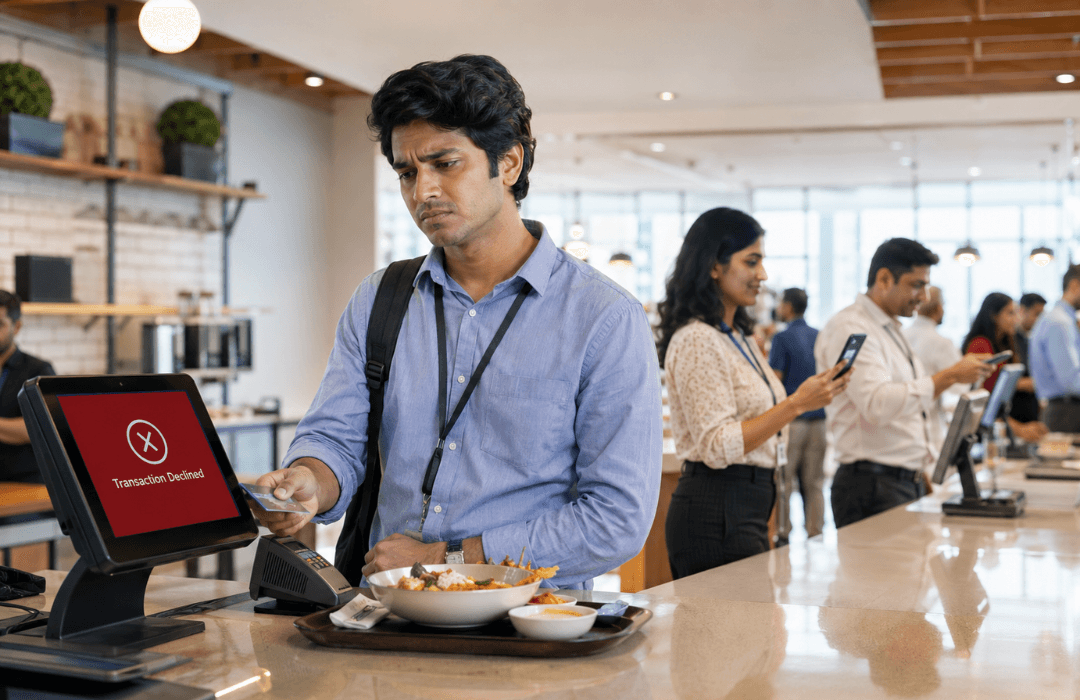
It’s lunch time, and an employee goes to a nearby cafe to use his meal card. The transaction is denied. He tries a popular fast-food chain close by. Again, the card is declined. This is how a meal card not working turns a simple perk into a hassle.
Traditional meal benefit programs often rely on restricted merchant networks. Employees can’t really use their cards freely, and this directly impacts usage. Meal cards for employees are designed to boost employee satisfaction and optimise tax savings. However, low adoption means much of that value is left unused.
Why Restricted-Network Meal Cards Limit Employee Adoption?
Meal card acceptance issues mean that employees can’t access their benefits easily, which decreases both trust and engagement. Here’s how meal cards with restricted merchant acceptance pose issues:
Limited Acceptance Causes Frustration
Many meal cards are only usable at merchants on the provider’s network. Today’s employees expect flexibility. They want to use their benefits at local restaurants, stores, and online food delivery platforms, be it Zomato or DMart. Employees end up paying out of pocket without the benefit of the card or a tax advantage, which defeats the purpose of offering employee meal card benefits to begin with.
Restrictions Mean Hassles
When employees find that their meal card is not accepted everywhere, it becomes a source of stress. The card may work in metros but not in Tier 3 cities or only at certain chains. Similarly, the card may not work at local grocery stores or fine-dine restaurants. Those travelling for work or living outside major metropolitan areas face even greater challenges.
Restrictions require employees to plan their meals based on card acceptance rather than personal preferences or convenience. This friction discourages the employee benefits adoption rate and makes the perk meaningless.
Low Adoption Means Wasted Employer Investment
Low adoption rates indicate that the selected solution is not addressing employees' needs. Consider that Indian employers usually spend between ₹2,200 and ₹15,000 or more per month on food per employee. With the latest updates in the Income Tax Act 2025, meal vouchers are now tax-free up to ₹1.05 lakh.
Whether the company offers this perk or additional meal benefits on top of it, the ROI matters. After all, food is one of the most appreciated employee perks, according to recent reports. When this perk is diluted by deductions, employees feel like they’re missing out, and employers wonder if it’s worth the investment.
How Do Hidden Charges Make Meal Cards Less Valuable?
Beyond acceptance, another issue can reduce employee meal card benefits. See how hidden charges lead to dissatisfaction.
Decreases Value
Many meal cards have convenience or transaction fees. The charges may be small, but they add up over time. An employee entitled to a monthly food subsidy of ₹3,000 may actually receive less after these charges. This gap can decrease trust and engagement
Creates Confusion
Some platforms have a variety of charges, including activation, annual maintenance, and reloading charges, along with inactivity fees. For most employees, these deductions come as a surprise. This leads to a lack of confidence in the benefit.
Impacts Employer Reputation
Although these fees are typically charged by the provider of the benefits, employees may see them as a cost agreed upon by the employer. This can affect their perception of the benefits.
Modern Solutions Solve Both Problems
Flexible benefit cards are built to bridge the gap where traditional meal cards fall short. Take a look below to see how.
Open Network Increases Usability
Modern meal cards work across popular payment networks like VISA and RuPay, allowing employees to use their cards across millions of merchants. This dramatically increases adoption and usage. It also ensures that employee meal card benefits are actually utilised.
Zero Hidden Fees Deliver Full Value
Some of the best meal cards in India now have zero convenience fees. This means that employees can use the full amount loaded onto the card without any deductions or surprises. The result is increased trust and increased utilisation with improved ROI for employers.
Restricted vs. Open Networks
Not all meal cards offer the same experience. Check the differences in the table below:
Feature | Restricted-Network Meal Cards | Open-Network Meal Cards |
Merchant Acceptance | Limited to partner network | VISA/RuPay networks (millions of merchants) |
Convenience Fees | Often charged on every transaction | Zero fees |
Geographic Coverage | Urban-centric, limited in smaller cities | Universal coverage |
Employee Experience | Frequent acceptance issues | Seamless, flexible usage |
Employer Value | Low adoption, wasted spend | High adoption, full benefit utilisation |
Experience the Future of Employee Benefits with Zaggle
Designed to address both acceptance and hidden cost challenges, Zaggle’s employee benefits card reflects the shift towards flexible, employee-friendly perks. Some of its features include:
Works Anywhere VISA and RuPay Are Accepted
Zaggle’s employee benefits card operates on open payment networks, eliminating meal card acceptance issues. Employees can use it at local restaurants, national chains, grocery stores, and even online delivery platforms, like Blinkit or Ratnadeep.
This universality means employees don't need to change their spending habits or plan meals around card acceptance. The benefit fits seamlessly into their daily lives, driving higher adoption and satisfaction.
Zero Convenience Fees = Full Value
Unlike many competitors, Zaggle charges zero convenience fees. This means every rupee loaded onto the card is available for the employee to use. There are no hidden deductions, no transaction charges, and no surprises.
Additional Benefits That Improve Experience
Beyond network access and fee structure, this solution offers:
Multiple Payment Modes: Swipe, tap and pay, scan, and online payments
Mobile-App Integration: Real-time transaction tracking and balance checks
No Bill Upload Requirements: Employees don’t need to submit receipts after every transaction
Multi-Benefit Consolidation: Meal and other benefits accessible via a single card
Conclusion
Flexibility, transparency, and ease of use are what make a perk a valued part of the employee experience. Open-network, transparent solutions are the need of the hour, and Zaggle’s employee benefits card allows employees to maximise value with no strings attached. Book a quick demo to see how our card and platform can work for your team.
Frequently Asked Questions
Do all meal cards charge convenience fees?
No. Some meal cards for employees come with convenience or transaction fees. However, modern employee benefits platforms like Zaggle offer zero convenience fees and have no hidden charges.
What are the most common meal card acceptance issues?
The biggest meal card acceptance issue is a limited merchant network. Some cards are not accepted outside the big cities, while some may be used only at certain types of outlets. Another reason for the decline in transactions is the incompatibility with newer payment systems.
Why is my meal card not accepted even when the outlet has a card machine?
A card machine alone does not guarantee that your meal card will work. Many meal cards operate on merchant networks, so the outlet must be part of the network for that transaction to go through. If your meal card is not working despite the merchant accepting card payments, the outlet may not be authorised to accept that particular meal card.
What should I look for in the best meal card in India?
The best meal cards in India are easy to use in everyday situations. Look for a card that works across a wide merchant network, like Visa or RuPay, so that you’re not limited to a small set of outlets. Transparent pricing is equally important. Hidden fees can reduce the actual value of your benefits. Features such as mobile app-based access, spend tracking, and multiple payment options can also help make the experience more convenient.
Why is my meal card not accepted at most restaurants?
If your meal card is not working at a popular restaurant, it may be a part of a restricted network. In many cases, the list of meal card accepted restaurants is limited to partner merchants within that network.
Zaggle Admin
Expert contributor and editor at the Zaggle Knowledge Hub, specializing in corporate spend management, expense compliance, and B2B fintech solutions.
In This Article
You May Also Like

Employee Smartphone Leasing: How Teams Get Flagship Phones at Zero Upfront Cost
Posted on : Oct 23, 2026

How Employee Device Leasing Works in India: Selection, Payroll and Ownership
Posted on : Oct 14, 2026

What Is an Employee Purchase Program? The Complete 2026 Guide for Indian Employers
Posted on : Oct 7, 2026