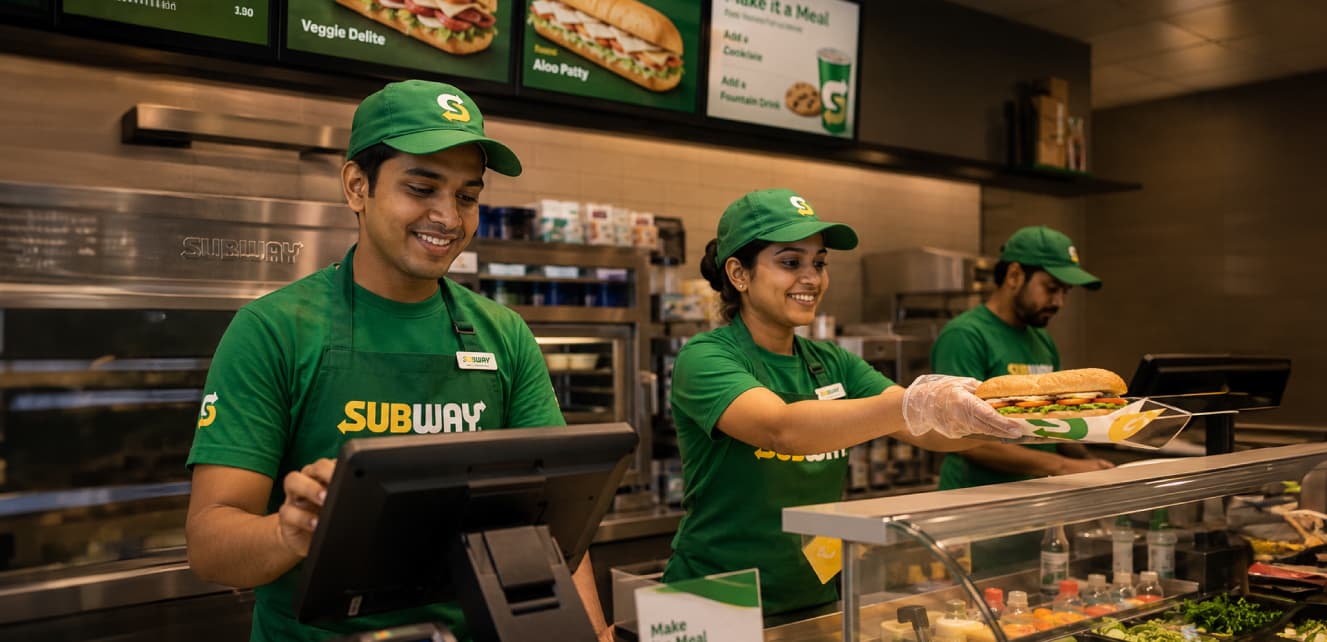
Subway is one of India's largest QSR networks, with a footprint of 500+ stores PAN India. Every store runs lean and fast and depends on small, frequent payments to operate: raw materials, garbage disposal, local repairs, ad-hoc supplies.
Multiplied across 500 outlets, those small payments add up to roughly lakhs of Rupees, in monthly petty cash spend that Finance has to track, reconcile, and account for.
Petty cash was leaking control, time, and working capital. Before Zaggle, every Subway store ran on physical cash floats. Store managers held ₹7,000–₹10,000 in cash to pay vendors as supplies arrived, garbage was cleared, or quick repairs were needed. What looked like an operational convenience was, at scale, a structural problem.
Cash on hand at every store. Across 500+ stores, Lakhs of working capital was sitting idle as physical cash floats every month- exposed to misuse, fraud, and human error, with no real-time view for Finance.
Reconciliation pain. Receipts were collected manually and matched against floats after-the-fact. Reconciliation routinely surfaced gaps, mis-postings, and missing slips, eating up Finance hours every cycle.
No control, no visibility. No store-level spend caps, no amount-based approvals, and no audit trail meant overspending and revenue leakages were hard to catch and harder to prevent.
Slow, manual approvals. Multi-step, manually owned approval chains stretched reimbursements to 10–15 days, slowing the front line and creating a dependency on people, not systems.
Unpredictable cash outflows. With no live signal on store-level outflows, month-end cash planning was a reactive exercise, Finance was forecasting blind.
A QR-led petty cash system, engineered for QSR.
Zaggle replaced physical cash with a UPI/QR-based petty cash system purpose-built for Subway's QSR operations. Store managers pay vendors directly from a controlled digital float; every payment automatically creates an expense record with the right context; and Finance sees it all- live from a single dashboard.
What we deployed
QR-led petty cash with auto expense creation. Vendors are paid via UPI/QR straight from the pool account balance. Every payment auto-generates an expense entry which means no paper slips, no after-the-fact data entry, and an instant digital trail for audit.
Store-level budget caps. Store-level monthly caps replaced unbounded floats. An ad-hoc budget option handles exceptions without bypassing control.
Amount-based approval workflows. Amount-based policies enforce skip-level approvals on bills above a fixed amount, so high-value spends always get a second pair of eyes.
Closing balance against every transaction. Built specifically for Subway: every transaction shows the running closing balance, so reconciliation is real-time, not month-end. This single change resolved their biggest historical pain point.
Real-time visibility in the admin dashboard. Live QR payment status, rejected expenses surfaced for Finance review, and a clean audit trail across 500+ stores.
Fully customisable to QSR operations. Seamless, system-agnostic integrations and configurable workflows shaped to how Subway actually runs.
500 hrs saved every month across Finance & Operations
80% reduction in duplicate expense submissions
10–15 Days to 1–2 Days reimbursement turnaround
₹0 physical cash float at stores
OPERATIONAL
Reimbursements that once took 10–15 days now close in 1–2 days. 3–4 FTEs previously absorbed by petty cash workflows have been redeployed to higher-value Finance work. Duplicate expense submissions are down 80%.
FINANCIAL
Physical cash floats at stores are now zero, releasing lakhs of working capital across the network. UPI-based payments make monthly cash outflows predictable allowing Finance to forecast, not react.
CONTROL
Store-level caps and amount-based policies eliminated overspending. Skip-level approvals catch every bill above ₹1,000. Rejected expenses are visible to management leading to a clean, transparent audit trail across 500+ stores.
“With savings of 500 hours per month across branches, Zaggle has also given us stronger visibility and control over our monthly cash outflows.”
— Radhesh Tailor, VP – Head of Accounts & Finance, Subway
Case Study
Posted on 30 Jul 2026
7 to 10 Days → 1 to 2 Days
Reimbursement processing turnaround
Improved Accuracy
Reduced manual errors and duplicate claims
Stronger Compliance
Automated policy violation checks
Case Study
Posted on 29 May 2026
90% faster reconciliation
cycle on long projects
Reduction in Cash leakages
due to policies and limits enforced through the platform
Books closed on time
helping Ramelex stay audit ready

Case Study
Posted on 28 May 2026
600+ finance hours
saved every month across stores and HQ
~100%
control achieved over cash leakages
2-3 hrs to 40 min
reduction in per-store petty cash handling time