
5 Best Practices to Cut Accounts Payable Processing Time

Summary
Slow Accounts Payable cycles drain cash flow and weaken vendor trust. This blog outlines five strategic, technology-ready practices that help Indian enterprises strengthen the procure-to-pay workflow and reduce delays without compromising compliance.
Why AP Delays Start Long Before an Invoice Arrives
Across medium and large enterprises in India, one reality is consistent. AP delays rarely begin in the finance department. They originate much earlier in the procurement cycle. A missing purchase order, unclear requisition, manual matching of documents, and unclear approval roles all slow down payment processing long before the invoice even reaches the AP team.
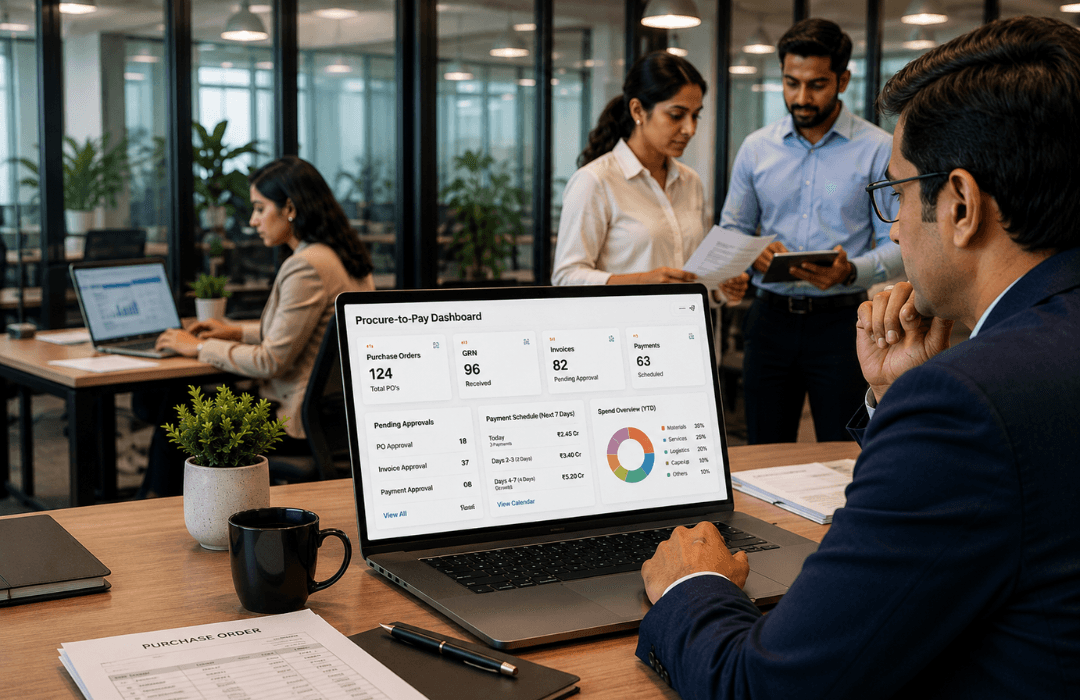
Studies reveal that invoice exceptions and fragmented documentation continue to be major roadblocks in the procurement cycle. Companies with structured and automated P2P workflows close payable cycles significantly faster than those dependent on email-based processes. Reducing AP processing time, therefore, requires strengthening procurement discipline, not just digitizing payables.
Below are five best practices that help finance leaders structure faster, compliant, and more predictable AP cycles.
1. Improve Procurement Inputs to Avoid AP Bottlenecks Later
When procurement starts poorly, AP ends poorly. Missing documentation, unclear specifications, and non-standard requisition formats require AP teams to clarify with departments repeatedly. This increases processing time and introduces compliance risk. Many studies have highlighted that enterprises with structured requisition hygiene and mandatory purchase order discipline experience fewer invoice exceptions.
Strengthening procurement inputs involves three essentials:
• Standardized requisition formats
• PO creation for every purchase
• Clear approval paths aligned with budgets
Modern P2P Automation platforms often support these improvements by enforcing requisition standards, ensuring PO creation, and maintaining consistency in the procurement cycle.
2. Replace Email Approvals with Centralized Digital Workflows
Email-based approval chains remain the single most significant hidden cause of AP delays. When invoices are circulated via email, it becomes difficult to track who is responsible, how long a document has been pending, and whether necessary clarifications have been addressed.
The Ardent Partners AP Metrics that Matter Report 2025 indicates that the best-in-class enterprises have leveraged technology and automated manual processes with excellent results. They report a 2.1 times higher rate of touchless invoices as one significant advantage.
Centralized workflow tools reduce delays because:
• Approvers receive timely alerts
• Visibility improves across the approval chain
• DOA alignment stays intact
• Exceptions reach the right owner immediately
3. Minimize Manual Invoice Matching and Verification Effort
Manual three-way matching is one of the most time-consuming steps for AP teams. Validating invoice details against purchase orders and goods receipt notes often results in repeated follow-ups, increased verification time, and a higher error potential. The Institute of Finance and Management notes that manual matching contributes significantly to cycle time extensions in traditional AP environments.
Automation helps by enabling:
• System-driven PO matching
• Assisted reading of invoice line items
• Instant discrepancy alerts
• Faster verification of supporting documents
Stop losing time to manual matching.
Explore structured AP workflows.
Improve P2P Processing Now
4. Build a Clear and Enforceable Delegation of Authority Framework
A weak DOA structure is a major contributor to AP delays. When spending limits are unclear or delegated approvers are not appropriately mapped, invoices often wait for approvals that should have been routed elsewhere. DOA clarity is critical for building faster and audit-ready AP processes.
A good DOA framework ensures:
• Spending thresholds are allocated correctly
• Parallel approvals speed up decision-making
• Approvals follow consistent logic
• Exceptions become easier to manage
Modern P2P Automation systems enable enterprises to embed DOA rules, allowing approvals to follow the correct path automatically and reducing manual interpretation and policy deviations.
If you want to explore how non-configurable complex DOA leads to compliance issues in your P2P process, read here.
5. Use Analytics to Detect Cycle-Time Delays Early
Cycle-time delays cannot be solved unless they are measured. Analytics helps enterprises identify:
• Slowest approval points
• Vendors with recurrent documentation issues
• Departments with repeated exceptions
• Average time taken for each AP step
Enterprises with visibility into cycle-time analytics respond faster to delays and optimize vendor management more effectively.
Stop reacting to AP delays.
See your bottlenecks clearly.
Drive Efficiency Now
Where Faster AP Meets Smarter Procurement Discipline
Across these five practices, the message is clear. AP efficiency requires disciplined procurement, predictable workflows, and real-time visibility. When these elements come together, finance leaders can reduce processing timelines, strengthen compliance, and improve vendor trust.
Integrated Procure-to-Pay solutions, such as Zaggle, are built around these principles. With automated workflows, PO discipline, configurable DOA, invoice matching, payment routing, and analytics, the platform aligns with the structural practices finance leaders seek. Its role is not to replace processes but to strengthen them across the procurement cycle.
A Faster AP System Begins with a Stronger Procurement Cycle
Reducing AP processing time involves designing a procurement cycle that avoids delays, improves accuracy, and provides finance leaders with greater control. With structured practices and the proper P2P Automation support, enterprises can shift AP from a reactive function to a driver of financial performance and vendor confidence.
Zaggle Admin
Expert contributor and editor at the Zaggle Knowledge Hub, specializing in corporate spend management, expense compliance, and B2B fintech solutions.
In This Article
You May Also Like

7 Proven Ways Medium and Large Enterprises Can Strengthen Their Procure to Pay Cycle
Posted on : Jul 3, 2026
From Purchase Orders to Payments: 7 Reasons Companies are Automating Procure to Pay
Posted on : Jun 17, 2026

Lack of Tighter Controls: How Non-configurable Complex DOA Leads to Compliance Issues in Your P2P Process
Posted on : Jan 11, 2025