
Company Car vs Personal Car: Tax Implications for Employees
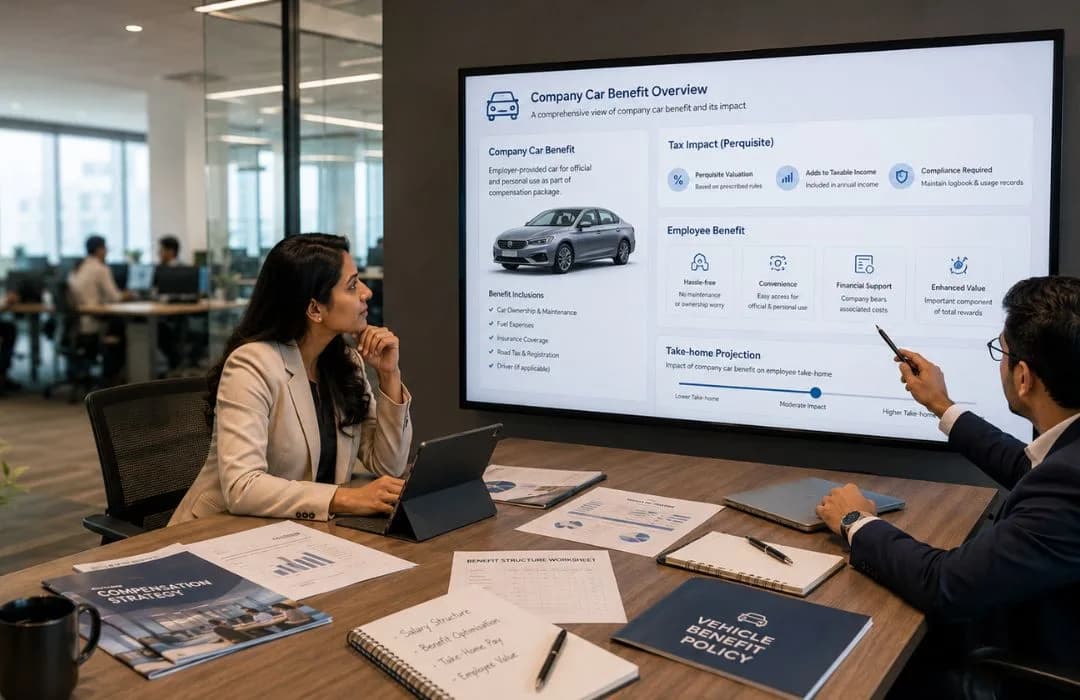
Rohit had just received his revised compensation structure, and, on paper, it looked great. Along with the increment, his company had added a car benefit. It felt like a clear upgrade—no need to worry about buying a car, managing maintenance, or dealing with fuel expenses.
When he sat down to actually understand the details, things were not as simple. With the recent Income Tax Act 2025 changes, some components of salary were being taxed differently. As he looked deeper into how cars are taxed in India, one question kept coming up: what is the real tax impact of using company car vs personal car?
The more he explored, the clearer it became that there was a noticeable tax difference between a company car and own car, and that choice could directly affect how much salary he actually took home at the end of the month.
Revised Tax Treatment of Company Cars Under the Income Tax Act 2025
One of the most notable Income Tax Act 2025 changes is the sharp increase in the taxable value of employer-provided cars. These revisions significantly raise the perquisite value assigned to company vehicles, thereby increasing the tax burden on employees.
Component | Earlier Value | Updated Value | Impact |
Car (<1.6L engine) | ₹1,800/month | ₹5,000/month | Higher taxable income |
Car (>1.6L engine) | ₹2,400/month | ₹7,000/month | Increased tax burden |
Chauffeur | ₹900/month | ₹3,000/month | Significant rise in taxable benefit |
What this means for employees:
The taxable value of company cars has increased substantially, even if actual usage remains the same
Employees receiving car and chauffeur benefits will see a higher portion of their salary treated as taxable income
These changes increase the overall tax liability associated with employer-provided vehicles
Compliance requirements for company cars:
The updated framework also introduces stricter compliance expectations. Employees availing company car benefits are required to maintain:
Detailed logbooks
Journey and destination records
Mileage tracking
Expense documentation
Failure to maintain these records can lead to higher taxable valuation being applied, increasing the tax burden.
Tax Difference Between Company Car And Own Car Usage: A Detailed Comparison
Employees using personal vehicles for work-related purposes can structure reimbursements in a way that improves tax efficiency. See the table below:
Factor | Company Car | Personal Car |
Taxable Value | Fixed monthly perquisite (increased significantly) | Based on fuel and driver expense structure |
Impact on Taxable Income | Higher due to revised valuation | Lower taxable value in comparison |
Tax Savings Outcome | Reduction in tax savings under new rules | Improvement in tax savings compared to earlier structure |
Compliance | Mandatory logbook and detailed records | Requires expense documentation |
In contrast, using a personal car for similar expenses results in improved tax savings under the updated framework. This becomes easier to manage when supported by digital expense management systems that improve visibility and simplify tracking of fuel and travel-related claims.
What These Changes Mean for Salary Structuring and Benefit Optimisation
The updated framework reflects a broader shift in how employee benefits are structured. There is a clear rebalancing between high-tax perquisites and more tax-efficient components within compensation.
In many cases, structuring benefits correctly can significantly improve take-home salary without increasing overall cost, especially when using flexible benefit structures effectively.
Key implications for organisations and employees:
Employer-provided car benefits now carry a higher taxable value, particularly for cars and chauffeur services
Personal car usage, when aligned with fuel and driver cost structures, can result in improved tax savings
Compliance has become a critical requirement, with detailed documentation needed to support benefit usage
Organisations may need to reassess vehicle-related policies and benefit structures in response to these changes
As organisations move away from rigid perks, adopting modern employee benefit strategies becomes essential for improving both tax efficiency and overall employee experience.
Managing employee benefits under the new Income Tax limit changes in 2026 can be complex. This is especially true with revised perquisite valuations, expanded HRA limits, and increased documentation requirements. Zaggle’s employee benefit solution helps organisations streamline benefit management, monitor usage, and adapt to the updated taxation framework.
Many traditional allowances, such as HRA, LTA, and meal vouchers, are now part of taxable salary rather than tax-exempt components. However, careful structuring and clear communication can still maximise the practical value of these benefits for employees.
By combining strategic planning with robust tracking and allocation, organisations can ensure compliance and optimise compensation design. This approach also helps employees make the most of available benefits under the new regime.
Most importantly, tax-efficient structuring is now possible even under the new tax regime. With the right mix of allowances and benefits, up to ₹3,24,000 of salary can be structured as tax-optimised income across both regimes. This reinforces the need to look beyond individual perks like company cars and focus on overall salary design to improve take-home pay.
Frequently Asked Questions
What is the tax impact of using a company car vs personal car?
The tax impact of using company car vs personal car differs based on valuation. Company cars are taxed at higher fixed values, while personal car usage results in relatively better tax savings under the updated rules.
How are company cars taxed in India under the new rules?
Company cars are taxed as perquisites using fixed monthly values, which have increased significantly under the Income Tax Act 2025 changes.
Why is documentation important for company car benefits?
Documentation such as logbooks, mileage records, and expense details is required to comply with tax rules. Failure to maintain these can result in higher taxable valuation.
What should organisations do in response to tax changes in company car usage?
Organisations should reassess vehicle benefits and ensure compliance with documentation requirements. Using digital employee benefit solutions, such as those offered by Zaggle, can help manage benefits more effectively.
Zaggle Admin
Expert contributor and editor at the Zaggle Knowledge Hub, specializing in corporate spend management, expense compliance, and B2B fintech solutions.
In This Article
You May Also Like

Why Payroll-Linked Employee Purchase Programs Drive Higher Adoption.
Posted on : Sep 22, 2026

How to Build an Employee Purchase Program with Premium Protection and Seamless Experience
Posted on : Sep 15, 2026

Old vs New Perquisite Rules: What Has Changed in the Income Tax Framework
Posted on : Jul 28, 2026