
Rent, Maintenance and Society Dues: Which Recurring Property Payments Actually Work on UPI?
India's office market continues to expand, with 82.6 million sq. ft. of office space leased in 2025. That translates to more offices, branches and commercial properties for businesses to manage, all of which have recurring costs. For finance teams, the challenge is deciding how each property expense should be paid, documented and reconciled.
UPI may be suitable for smaller, recurring or site-level property payments, while larger contractual payments such as commercial rent may require more formal payment processes. The choice should be based on payment value, payment frequency, documentation, acceptance by the recipient, limits and compliance requirements for finance.
The correct way to do it is to align the payment method with the type of expense.
Why Property Payments Need a Different Approach
Payments may be as small as a repair at a branch or as large as a monthly commercial rent payment. Treating both in the same way creates unnecessary problems. A repair bill of ₹2,000 paid to a local technician is comparatively easier using UPI. But a high-value commercial rent payment requires a formal lease, supporting documentation and possibly tax withholding requirements.
The nature of the expense matters alongside its value. A ₹2,000 local repair and a monthly contractual rent payment may both be recurring business expenses, but they can have very different documentation, contractual and compliance requirements.
UPI can help with convenience at the payment stage, but Finance requires a full record of what was paid, to whom, for which property and under what arrangement. UPI is a payment rail. The organisation still needs the appropriate documentation, attribution, controls and accounting process around the expense.
Which Recurring Property Payments Work on UPI?
Not all property costs are the same when it comes to payments. The choice will depend on the quantity, frequency, recipient, documentation and compliance needs.
Office or Commercial Rent
Finance teams should be extremely careful with rent. UPI might be viable where the transaction value, contractual arrangement, documentation, recipient acceptance and applicable requirements make it appropriate. But high-value commercial rent should not be automatically transferred to UPI just because the landlord accepts it.
First, the value of the transaction, the organisation's current payment process and the documentation needed for the lease should be taken into account. Businesses also need to consider the TDS liability on rent.
A payment trail is not a replacement for compliance, as rent payments continue to be subject to TDS provisions, if applicable. The landlord accepting UPI does not by itself mean that UPI is the appropriate payment method for the business. An existing bank or Finance process might therefore still be the best solution for larger rent payments.
Building and Facility Maintenance
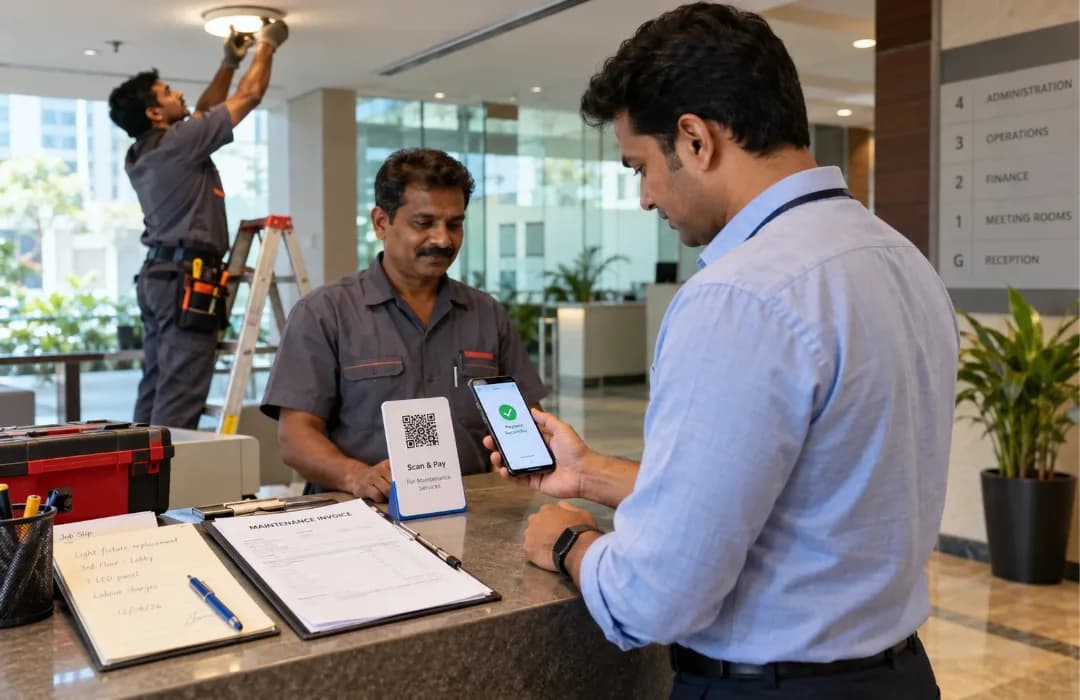
UPI may be more suitable for maintenance payments, especially if they are recurring payments to building service providers, local vendors or facility contractors. Examples can include housekeeping services, facility management services and local maintenance contractors. The decision will still be based on the invoice amount and the recipient's UPI acceptance.
The key for Finance is that the payment must create a usable transaction record and be traceable back to the property and expense. It should also be attributable to the relevant branch, property or cost centre.
Society or Association Dues
Society or association payments can often work well with UPI where the association provides a UPI-enabled payment option. The association's acceptance of UPI and availability of the relevant payment mechanism are prerequisites. These payments are generally easier to manage when the business retains the relevant demand note, invoice or receipt alongside the digital transaction record.
For businesses operating from multiple buildings or commercial complexes, the bigger challenge is often not making payments. It is knowing which property, branch or location the payment relates to and whether it was completed within the expected payment cycle.
Smaller Site-Level Property Payments
Small property expenses are often the strongest use case for UPI. A branch may need to pay a local electrician, plumber, locksmith or repair vendor. A site may need minor maintenance supplies or an urgent facility-related service.
These expenses are often frequent, operational and location-specific, which makes them particularly relevant to a controlled digital payment process.
Using personal UPI accounts and claiming reimbursement later can create another layer of processes. Personal UPI and reimbursement should not be the default business workflow when a controlled business payment mechanism is available. A controlled business QR code payment can allow authorised employees to make these payments directly while keeping the transaction within the expense process when using UPI for business.
What Finance Teams Should Consider Before Using UPI
The Use the following as a Finance decision checklist before moving a property expense onto UPI. But note that the best payment method depends on more than whether a recipient accepts UPI.
Transaction Value and Limits
UPI transaction limits are not the same for every type of payment. NPCI has increased limits for certain categories, but banks and other participating entities can also apply their own internal limits. Finance teams should therefore check whether the specific property payment fits the applicable limit rather than assuming that any amount can be paid through UPI.
Payment Frequency
A one-time maintenance payment and a fixed monthly rent payment have different operational requirements. Frequent, lower-value property payments may benefit from a digital workflow, while larger fixed contractual payments may require a more formal scheduled payment process with stronger documentation and tax controls.
Documentation
A digital transaction record does not replace the underlying invoice, agreement or supporting document. Finance teams should still retain the documentation required to establish what the expense relates to and how it should be accounted for.
Landlord or Recipient Acceptance
UPI only works when the recipient is set up to receive it. A landlord, society or maintenance provider may prefer another payment method. The payment rail should therefore be agreed as part of the commercial or operational arrangement rather than assumed.
Tax and Compliance Obligations
The payment method does not remove tax responsibilities. For rent and other specified payments, finance should assess applicable TDS and reporting requirements before deciding how the transaction will be made. The Income Tax Department's current guidance confirms that TDS provisions continue to apply to relevant payments under the Income Tax Act, 2025.
Ownership and Attribution
A property payment should be traceable to a specific location, department, cost centre or responsible employee.
How Zaggle Helps Organise Recurring Property Expenses
Zaggle's Business Recurring Expenses solution helps businesses bring location-level operating expenses into a more organised workflow. Authorised employees can use UPI spends on the Zaggle App to pay merchants via QR code for appropriate expenses. This makes it convenient for a business QR code payment without having to use personal UPI accounts.
This is especially helpful for smaller maintenance payments, local repairs, local vendor payments and other site-level costs that are more easily paid digitally than in cash. It can also provide Finance with more visibility of payments, supporting documentation and ownership across locations.
The trick is not to push all property payments to UPI. It is to provide a mechanism to use UPI where it is suitable and to keep existing processes in place for payments that need a different payment rail.
Real Impact: How Ramelex Made Site Payments More Practical with QR
Ramelex required a solution to accept payments at various sites, including places where traditional card payments were not always possible. QR-led payments provided a digital solution for site teams to use for eligible local expenses, and reduced the need for cash-based payment processes.
The move enabled Ramelex to reconcile 90% faster, minimise cash leakages, and provided the business with greater visibility of spending at site level.
The takeaway for Finance teams is not that all recurring property payments should be shifted to UPI. Smaller maintenance, repair, local vendor and other site-level expenses can be good candidates for QR payments when the recipient accepts UPI and the transaction meets the business's limits, documentation and control requirements. Larger contractual payments may still be better handled through established formal payment processes.
Frequently Asked Questions
Can businesses pay rent through UPI?
Yes, where the recipient accepts UPI and the transaction fits the applicable limits and business process. High-value commercial rent should also be assessed for documentation, contractual requirements and applicable TDS obligations.
Which property expenses are best suited to UPI?
Smaller maintenance payments, local repairs, local vendor payments and other site-level expenses are often better suited to UPI than larger contractual payments.
Can society dues be paid through UPI?
UPI for business can work if the society or association accepts UPI and provides the relevant payment mechanism. Businesses should retain the relevant demand note, invoice or receipt for accounting and reconciliation.
Does paying through UPI remove the need for documentation?
No. The digital transaction record complements supporting documents such as invoices, agreements and receipts. It does not replace them.
Is UPI suitable for all recurring business expenses?
No. The right payment method depends on the transaction value, frequency, recipient acceptance, applicable limits, documentation and compliance requirements.
What is a business QR code payment?
A business QR code payment allows an authorised employee to make a business payment by scanning a merchant QR code. Within a controlled business setup, the transaction can also be linked to the organisation's expense-management process.
Can businesses use UPI without relying on employee reimbursements?
Yes. A business-controlled payment setup can allow authorised employees to make direct UPI payments for smaller maintenance, repair, local vendor and site-level expenses, instead of paying from personal accounts and claiming reimbursement later. Larger contractual payments may still require a more formal payment process.
Zaggle Admin
Expert contributor and editor at the Zaggle Knowledge Hub, specializing in corporate spend management, expense compliance, and B2B fintech solutions.
In This Article
You May Also Like

Business QR Code Payment vs Cash Float: What Should Branch Managers Use?
Posted on : Oct 6, 2026

4 Ways to Prevent Petty Cash Shrinkage Digitally
Posted on : Sep 29, 2026

UPI for Business: What Finance Teams Should Set Up Before Rolling It Out to Employees
Posted on : Sep 25, 2026