
From Cash Vouchers to QR Codes: How India's Everyday Business Spends Moved to UPI
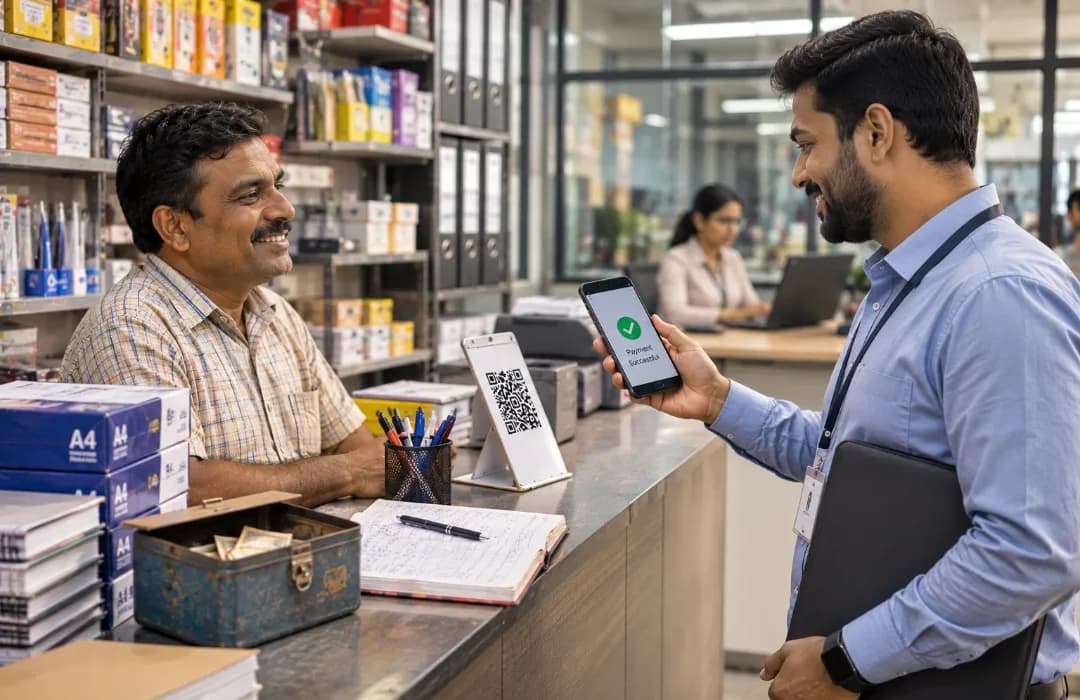
Everyday business expenses such as petty cash, local vendor payments, maintenance, property-related costs and utility bills may begin small but become harder to manage as businesses scale. Unlike larger finance functions, many of these recurring operational expenses still rely on fragmented processes across branches and locations.
But the switch from cash vouchers and reimbursements to UPI and QR payments does not only mean switching how businesses pay. It also means changing how recurring operational expenses are initiated, documented, monitored and reconciled.
Why Everyday Business Expenses Are Hard to Manage
While expenses like travel and procurement have been extensively covered in the area of finance digitisation, these larger categories have benefited from significant digitisation, while smaller recurring operational expenses often remain fragmented across branches and locations.
Say a branch needs to pay its local vendor, purchase inventory, clear a maintenance charge, pay a utility bill or cover a recurring property expense. When these expenses occur across multiple branches or locations, tracking and reconciling them can become a much larger administrative task.
Traditionally, the process has moved through a series of steps:
Cash float and paper vouchers
Employees using their own money to pay the amount
Reimbursement claims
Following up for and collecting documents
Manual reconciliation in the branches
As businesses started moving away from physical cash, electronic payment methods reduced some friction at the point of purchase. However, the underlying expense process still depended on how transactions were documented, approved and reconciled.
However, simply making the payment digital does not automatically make the whole process digital.
How Business Spending Moved from Cash to Digital
The evolution took place through different stages:
Cash Floats and Paper Vouchers
Petty cash allowed branch or site teams to have cash at their disposal to cover smaller costs.
However, cash could remain idle across locations between purchases, while Finance still had to track who held it, collect physical documentation and replenish the float periodically.
As organisations grew, managing cash across different locations became more and more complicated. Multiple branches and sites could have separate cash balances, frequent low-value transactions and different documentation, making central oversight harder.
Employee-paid Expenses and Reimbursements
The use of electronic payments minimised the need for physical cash; however, employees would often still cover business-related expenses out-of-pocket and then receive reimbursement. The payment had become digital, but the expense-management process remained fragmented.
The employee paid first. The proof of the transaction followed later. Finance then had to verify, approve, reimburse and reconcile the cost. This added administrative work for both employees and Finance teams, particularly as transaction volumes grew.
Digital Payments and QR codes
UPI made digital payments more convenient for businesses and employees, reducing dependence on physical cash and simplifying payments to local vendors and service providers. A business QR code payment enables an authorised individual to make payments to any eligible vendor or service provider digitally, without involving physical cash.
The payment process may be instant, yet Finance still needs to know:
Who made the payment?
What was paid for?
At what location was that cost incurred?
Whether it is under the budget allowance?
Where is the receipt?
How will you reconcile it?
This is where the next stage of the evolution begins.
Controlled, Visible and Integrated Spend Management
The next stage in the evolution of business spends is not simply to replace cash with digital payments. It is to connect everyday operational expenses with employee authorisation, budgets, supporting documentation, approvals, accounting and reconciliation.
This creates consolidated visibility across locations, strengthens accountability, reduces manual intervention and gives Finance and Operations teams a more consistent way to manage recurring expenditure.
Why Digital Payments Alone Are Not Enough
While a digital transaction generates a payment record, the lack of consolidated payment data can still cause problems when it comes to assigning payments to the right branch and department. If there is no consistent association between the transaction and the cost centre, budget or accounting record, Finance may still need to reconcile data manually and take more time to prepare accurate financial reporting.
Similarly, using personal UPI accounts for business expenses can continue to create reimbursement workflows. A controlled UPI for business process can connect the payment to authorised users, spending limits and business expense information right from the beginning.
Another crucial aspect of the process is documentation. Receipts and invoices that are collected much later may require Finance to chase missing documents, manually match them to transactions and close the gaps before the expense can be reconciled.
This is where QR payments become more useful when they are linked to expense controls and reconciliation. This is also true for recurring property and utility costs, where Finance may also require due-date tracking, along with visibility into supporting documents and the payment status.
What a Controlled Business Payment Workflow Should Include
The goal shouldn't just be to get rid of cash and use a business QR code payment. Rather, it is to link the payment to the information that Finance requires before, during and after the payment. This provides a more thorough spending history throughout the organisation. The spend management question for Finance teams shifts from "Was the payment made?" to "Can we understand, control and reconcile the payment?"
The table below outlines how connecting transaction data with the relevant expense, supporting documents and accounting information can make reconciliation easier. A digital transaction record alone does not automatically complete reconciliation:
Step | What it should include | Benefit for Finance Teams |
Authorisation | Approved users and locations | Controls who can spend |
Limits | User, branch or transaction limits | Controls exposure |
Payment | Digital payment through an approved method | Reduces cash dependence |
Attribution | Branch, department or cost centre | Establishes ownership |
Documentation | Receipt, invoice or supporting bill | Supports verification |
Approval | Rules based on amount or expense type | Strengthens governance |
Reconciliation | Transaction matched to expense | Reduces manual effort |
How Zaggle Helps Manage Recurring Business Expenses
Zaggle’s Business Recurring Expenses solution is designed to bring recurring operational spending into a more structured process across branches and locations. It covers three prominent areas: petty cash management for branch-level spending and reducing dependence on physical cash, rental management for recurring property-related payments across locations, and utility payments management powered by Bharat Connect for bill visibility, due dates, payment status and reconciliation.
The The objective across these areas is not to force every recurring expense onto one payment method. It is to bring fragmented operational expenses into a unified, structured process with greater visibility, control and easier reconciliation.
Real Impact: How Ramelex Moved from Cash to QR-led Site Payments
Management of payments through multiple project sites proved to be a pragmatic problem for Ramelex. Payment of cash required the distribution of cash by couriers, and the Finance team had little insight into how it was used.
Ramelex introduced QR-based payment at project sites using Zaggle to allow authorised teams to make eligible payments through the QR method, minimising dependency on cash.
This helped Ramelex get:
90% faster reconciliation
Minimal cash leakages
Better real-time insight into site-level spends
More control over project-related payments
Using QR payments made it possible for the site team to make payments when necessary without depending on cash couriers, and also Finance could have better digital tracking and reconciliation.
The Ramelex study shows how moving from cash to QR becomes more meaningful when the payment is part of a broader spend-management process.
For organisations dealing with multiple branches or sites, this serves as an example where a business QR code payment plays a more significant role when it is part of a spend management system.
Frequently Asked Questions
What is a business QR code payment?
A business QR code payment allows an authorised employee or business user to make an eligible payment by scanning a merchant QR code. When connected to spend controls, the transaction can also become part of the organisation's expense-management process.
What is UPI for business?
UPI for business refers to using UPI for eligible business payments while applying controls around users, limits, approvals, attribution and visibility.
Why are businesses moving from cash to QR payments?
QR payments can reduce dependence on physical cash, reduce physical cash handling and create a digital transaction record. However, businesses still need controls, documentation and reconciliation around those transactions.
Can employees use UPI for business expenses?
Yes. Businesses can enable authorised employees to make eligible UPI payments while applying appropriate spending limits and monitoring.
Does moving from cash to UPI eliminate reimbursements?
Not necessarily. If employees continue using their personal UPI accounts, businesses may still need to reimburse them. A controlled business payment setup can reduce this dependency by keeping eligible business spending within the organisation's payment workflow.
Is UPI suitable for every recurring business expense?
No. The right payment method depends on factors such as transaction value, frequency, recipient acceptance, documentation and internal controls.
What should Finance look for beyond digital payments?
Finance teams should consider authorised users, spending limits, branch or cost-centre attribution, documentation, approvals, budget visibility and reconciliation.
What is the role of QR payments in recurring business expenses?
QR payments are part of the broader shift from cash and employee reimbursements to controlled digital management of recurring business expenses. Their value increases when they are connected to controls, tracking, documentation and reconciliation.
Zaggle Admin
Expert contributor and editor at the Zaggle Knowledge Hub, specializing in corporate spend management, expense compliance, and B2B fintech solutions.
In This Article
You May Also Like
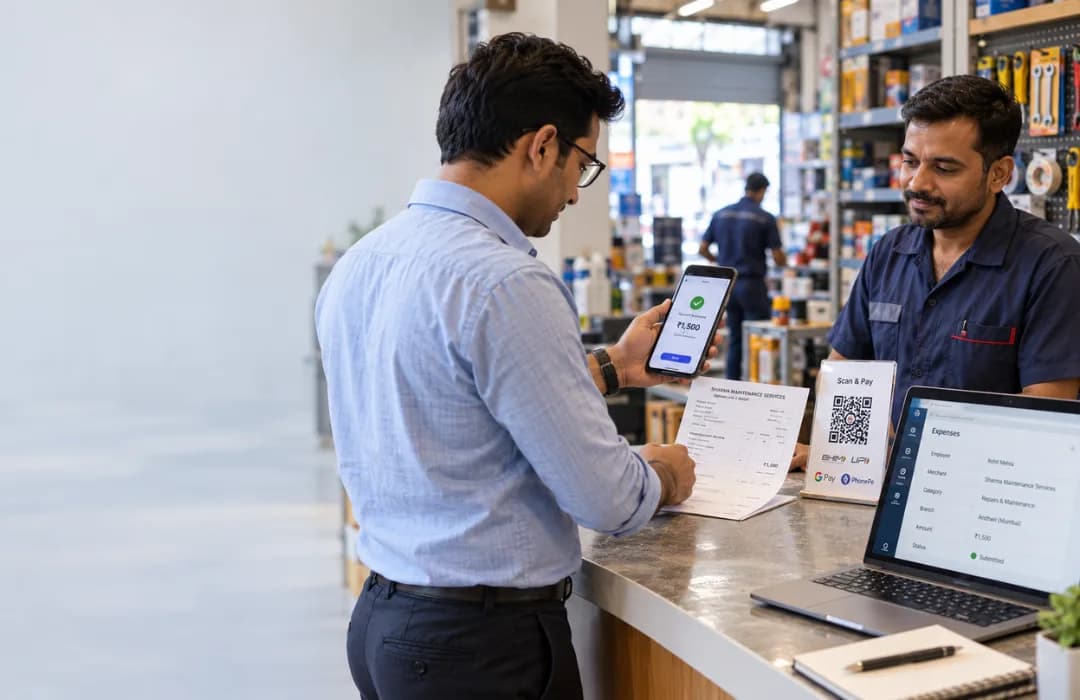
How to Make Every Business QR Code Payment Finance-Ready
Posted on : Nov 4, 2026
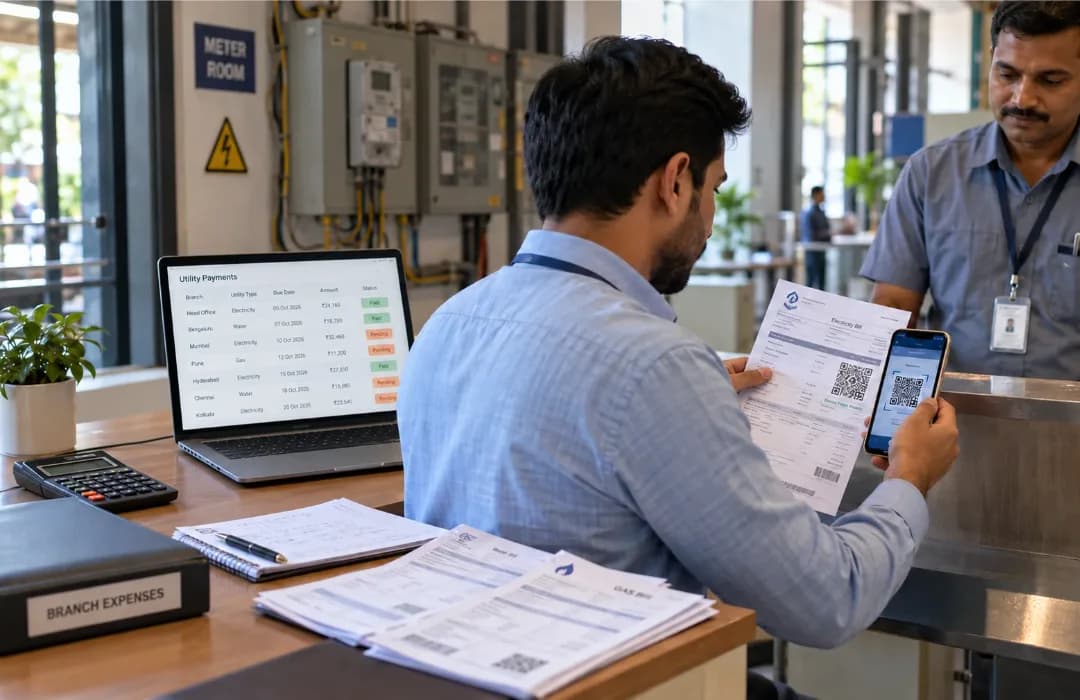
Paying Utility Bills Across 40 Locations: Where UPI Fits and Where It Doesn't
Posted on : Oct 28, 2026

How QSR Chains Can Eliminate Cash Leakages with QR-based Payments
Posted on : Oct 26, 2026